The 5 Pillars of Islam – A Step by Step Comprehensive Guide
Introduction
The Five Pillars of Islam are the most important acts of worship and the promises that define a Muslim’s faith and life. They are commonly referred to as the foundations of a Muslim’s responsibilities, and they constitute the basis of Muslim life. With AlQuran desk worldwide, all these pillars, Shahada (faith statement), Salah (prayer), Zakat (charity), Sawm (fasting during Ramadan), and Hajj (pilgrimage), make every Muslim a correct believer and a practitioner. Through the performance of these tasks, believers organise their worship, personality, and social tasks. Indicatively, Prophet Muhammad (peace be upon him) said, “Islam rests on five [pillars], that is, testifying that there is no God except Allah and that Muhammad is the Messenger of Allah, establishing the prayer, paying the Zakah, making pilgrimage to the House and fasting during Ramadan. It is a detailed guide to each of the pillars, as well as providing a hint at how these pillars can be integrated into Quran classes and curriculum.
The Islamic faith is constructed on five basic worship practices, which are referred to as the Five Pillars of Islam. These are the pillars that furnish the comprehensive structure of spiritual, social and moral life of a Muslim. They will instruct the believer on how to have a great relationship with Allah as they create disciplines, compassion and faith. Since professing faith is one pillar and Hajj the other, all of them educate Muslims on the importance of having a balanced and meaningful life. Such worship is not a separate exhibition of rituals but has a strong association with studying the Quran and Islamic doctrines.
Five Pillars of Islam:
The Prophet {Silla Llahu Alaihling WaSallam) said:
The Islamic faith is founded on five pillars: witnessing that Allah is the only God and Muhammad is the Prophet of Allah, instituting prayer, paying Zakat, undertaking Hajj and fasting during Ramadan. (Sahih Bukhari 8, Sahih Muslim 16). These pillars are a totality of worship which defines the spiritual nature of all Muslims. The main worshipping activities of Islam are the five pillars, which distinguish what a Muslim believes and practices. They include:
The online Quran education enables Muslims to learn Islam from the comfort of their homes all over the world, and they are able to cultivate the spiritual discipline they require to practice Salah, fasting, charity, and Hajj.
Shahada – Witnessing to Faith
Salah – Daily Prayer
Zakat – Charity
Sawm – Fasting in Ramadan
Hajj – Pilgrimage to Makkah
1. Shahada – Witnessing to Faith
Shahada – Witnessing to Faith
The first pillar in the Islamic religion is the Shahada, which forms the basis ofthe Muslim faith.
La ilaha illa Allah, Muhammadur Rasulullah
أشهد أن لا إله إلا الله وأشهد أن محمدًا رسول الله
Translation:
“I bear witness that there is no god but Allah, and I bear witness that Muhammad is the Messenger of Allah.”
This is the statement that proves the belief in the Oneness of Allah and submission to Prophet Muhammad as the last messenger of Allah.
Each Muslim starts his pilgrimage with the Shahada. It is repeated during prayer and makes believers remember that everything they do as a form of worship should be done in good faith to Allah himself.
It is the mere statement of there being no other God than Allah and Muhammad, the Messenger of Allah. The statement makes Tawhid (oneness of God) and acceptance of Prophet Muhammad (PBUH). All Islamic beliefs rely on the honest declaration of the Shahada that makes one a Muslim. Shahada is the testimony that they believe in only one God (Allah) and his messenger. By saying this creed, an individual is admitting the monotheism and prophethood of Muhammad. Practically, Shahada is the basis of all the beliefs of the Islamic religion – without that, the other pillars will be meaningless.
The Qur’an says:
So know that there is no God other than Allah.
(Quran 47:19)
The Shahada forms the religious pillar on which all others are rooted.
2. Salah – Daily Prayer
The second pillar of Islam is Salah, which is one of the most significant worship practices. Muslims have five prayers in a day:
Fajr
Dhuhr
Asr
Maghrib
Isha
Prayer makes the believer closer to Allah and gives a serene heart.
Allah says:
Enshrine prayer in My memory.
(Quran 20:14)
It is necessary to learn the proper way of praying, and this cannot be done without knowing Quranic recitation and Tajweed. That is why a lot of families attend Quran classes prior to the period of Ramadan to improve the quality of their prayers.
Online classes are beneficial to students:
- Memorize Surahs
- Proper pronunciation is a thing to learn.
- Understand prayer meanings
- Constitute uniformity in prayer.
This is something that prepares Salah as a daily ritual into a spiritual practice.
Salah (or Salat) pillar obligates Muslims to pray five times a day at specific times of the day, namely dawn (Fajr), noon (Dhuhr), afternoon (Asr), evening (Maghrib), and night (Isha). Salah is a prayer that is done five times a day, and it is a direct connection between the worshiper and Him. Muslims use Salah to show their thankfulness and devotion to God; Salah provides them with chances to reflect spiritually, show thankfulness, and submission.
These are prayers, which include certain physical movements (standing, bowing, prostrating), and Quran recitations, such as Al-Fatiha. Students are taught to know key duas (supplications) as a part of Salah. Interestingly, the course of AlQuranDesk named Learn Dua and Prayer Online is aimed at this to ensure that the students learn to perfect the art of praying and day-to-day supplications. The online course focuses on proper pronunciation and interpretation of the main duas (in Ramadan, in breaking fast, etc.), which supports the Salah pillar in the practical context.
The practice of praying five times a day helps a Muslim develop discipline and be conscious of Allah. Salah breaks up the day with prayer and serves as a constant reminder of religion. The Prophet (PBUH) even indicated that neglecting prayer is a difference between an individual and faith, and it is the main factor. In a nutshell, Salah is a worship exercise that helps a Muslim to strengthen his or her relationship with Allah daily.
3. Zakat – Charity (Almsgiving)
One of the pillars is Zakat, an obligatory charity that requires donating a specific portion of wealth to the poor. Zakat literally translates to purification and is a voluntary process where individuals give one-fifth to one-tenth of their savings or accumulated assets every year. According to Alquran desk worldwide, Zakat is the act of giving part of a Muslim’s wealth to the needy during their lifetime. This is not only to serve the poor but also cleanse the wealth and soul of the individual doing it.
The third pillar of Islam is Zakat, which is the worship of money. Muslims, who achieve the necessary amount of wealth, are obliged to donate 2.5 per cent of their savings during a year to the poor.
Allah says:
And set up prayer and impose Zakat.
(Quran 2:110)
Zakat cleanses the money and aids in poverty alleviation in society.
It educates a child and an adult on being generous and compassionate. Through Zakat, Muslims are taught that wealth is a trust of Allah.
The Prophet {Silla Llahu Alaihling WaSallam) said:
The wealth does not become less charitable.
(Sahih Muslim 2588)
To practice Zakat, one will need to learn about Islamic rulings, and this may be achieved by taking up classes in the Quran and Islamic studies.
Online learning programs will enable Muslims to know more about the wisdom of charity and social justice in Islam.
Zakat enhances social good and economic equality. This is because it makes charity a requirement; hence, redistribution of wealth will always go on. According to the Muslim Aid guide, these are the pillars that form the basis of the duties of a Muslim, and, in particular, Zakat is mentioned.
Practically, Muslims work out and pay Zakat either in Ramadan or at the end of the year. The Islamic precepts promote charity – the Quran states that God doubles the reward of those who spend it in his name. Zakat is taught to many AlQuranDesk students, as a concept of learning the Islamic values; in one example, it is taught that the New Muslim course teaches the basics of Zakat in a simple language.
To conclude, Zakat is not just a voluntary charity, but a worship that creates empathy and community. It serves the Quranic directive to take care of the poor (e.g. Quran 9:60) and is viewed as an obligation to those who pass the wealth requirement. The act of Zakat helps believers to aid the needy and enhance social responsibility and compassion in society.
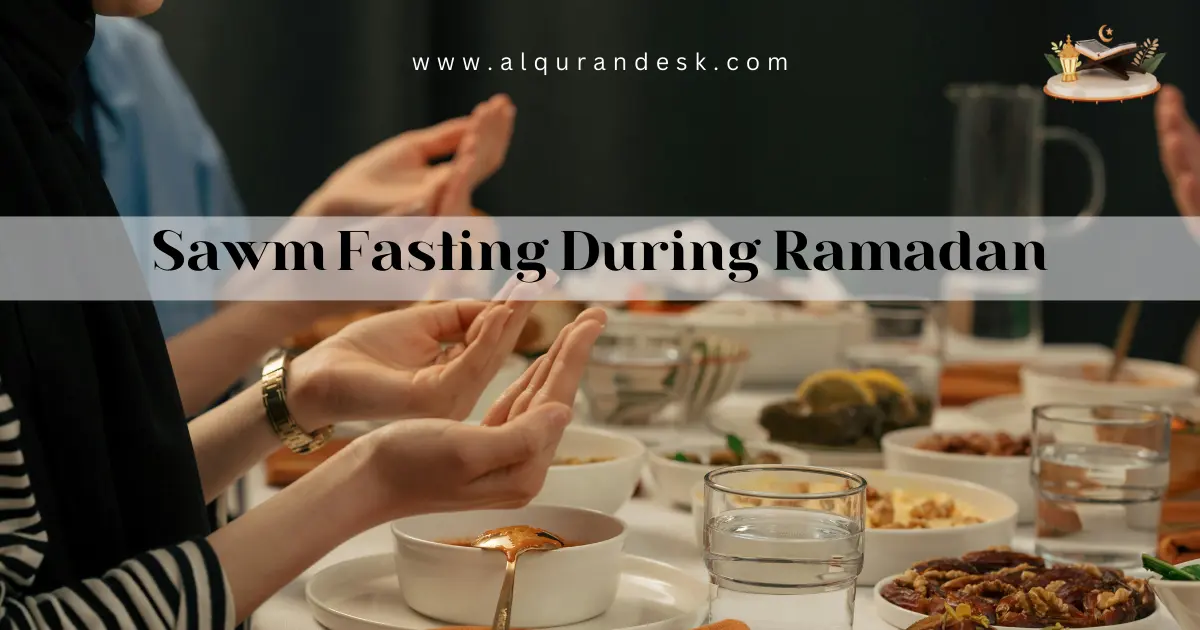
4. Sawm – Fasting During Ramadan
The fourth pillar of Islam is called fasting during Ramadan. Sawm is the process of fasting throughout the month of Ramadan. Adult Muslims (who are healthy and not travelling) fast between dawn and afternoon during this holy month without eating, drinking, or engaging in other behaviours.
Fasting is a type of worship that develops self-discipline, empathy and spirituality. According to The Muslim Hour, Sawm brings about self-control, spiritual contemplation and sympathy towards the less fortunate: This is a reminder to the believers as they experience hunger and restraint as to what the hungry go through, and as a reminder of what the heart is centred on, God. Besides avoiding the physical needs, Muslims aim to avoid engaging in sinful behaviour during Ramadan. After a day of fasting, every day the fasting is broken with iftar, which begins with dates.
The obligatory Sawm takes place once a year, and the ill, the travelling, the pregnant, and those who are not able to fast due to other reasons are allowed to be excused or make up the missed fasts in the future. This yearly fast ends up in Eid al-Fitr, a prayer and community charity festival. By and large, Sawm is the lesson of patience and piety: as it is written in the Quran, the purpose of fasting was that you might become attentive [of Allah]. By performing Sawm, Muslims reinvigorate their spiritual orientation and acquire empathy, which puts them in line with the spiritual practices of the past religious societies.
Muslims spend the day fasting, which is without eating, drinking, or committing sin.
Allah says:
O you who believe fasting has been prescribed to thee just as it was prescribed to those who preceded you that thou may become righteous.
(Quran 2:183)
The month of the Quran and the spiritual development is Ramadan.
The Prophet {Silla Llahu Alaihling WaSallam) said:
Those who fast Ramadan and do so with faith and reward in mind will have forgiveness of their past sins.
(Sahih Bukhari 38)
Quran learning as a means of preparing for Ramadan enables Muslims to get the best spiritual value out of the fasting.
It is more meaningful and spiritual to study before Ramadan and then fast.
As the month of Ramadan, a blessed month by the Muslims, approaches, most of the Muslim community gets ready spiritually by enhancing their attachment to the Holy Quran. Online Quran classes are one of the most effective methods of preparation by means of systematic learning. Such programs as Top 7 Benefits of Online Quran Classes before Ramadan would assist students to recite, Tajweed, and comprehend the Quran to practice the pillars in a more knowledgeable and heartfelt way.
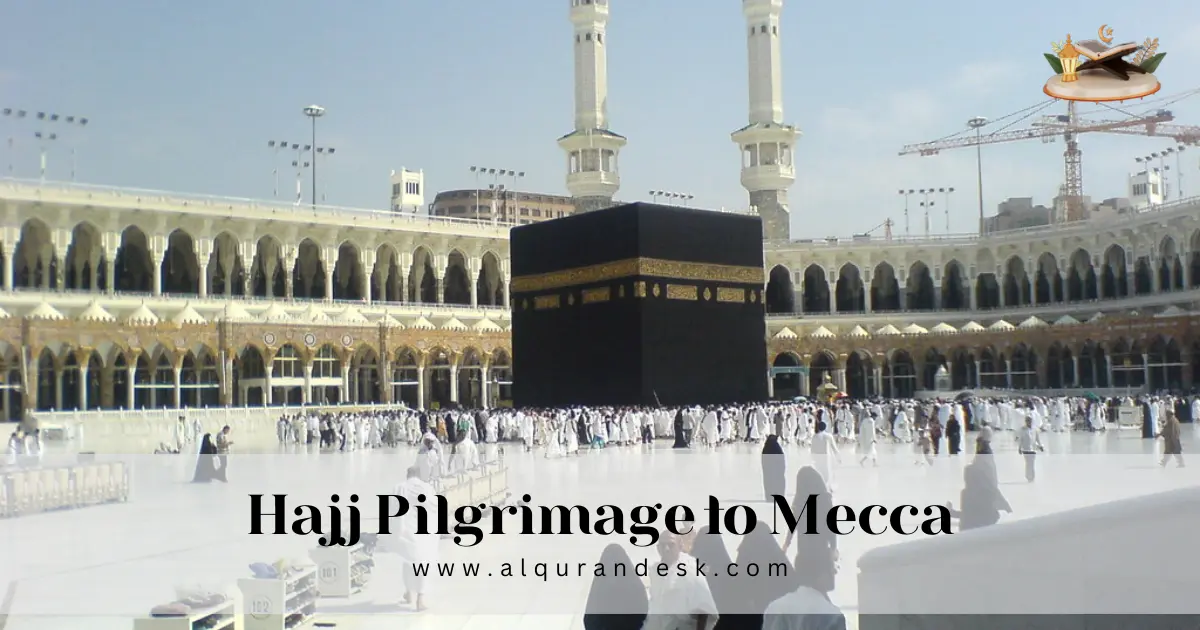
5. Hajj – Pilgrimage to Mecca
This pilgrimage is to the holy city of Mecca, which all Muslims should visit at least once in their lives, provided their physical and financial resources allow it. According to the Islamic Relief, Hajj is the holy pilgrimage to Mecca, which every Muslim must make at least once during his or her lifetime, provided there is money to do so. Hajj takes place during the final month of the Islamic calendar (Dhul-Hijjah), and includes several rituals in its practice: standing at Mount Arafat, circling the Kaaba (tawaf), running between Safa and Marwah, and the ritualistic stoning of the devil.
Hajj is one of the examples of unity and equality. All social differences are put aside when pilgrims don plain white clothes (ihram) and pray together. This makes the lesson of equality of Muslims in the eyes of God stronger. The fulfilment of Hajj meets one of the pillars; the Prophet (PBUH) said that doing Hajj as obligatory means that one fulfils their obligation.
Notably, Islam offers options to people who cannot afford the physical pilgrimage. As an example, one is allowed to undertake Hajj Badal on behalf of someone unable to attend (incapacitated by age or a sick parent). The Muslim Hour concludes that the Five Pillars are the basic building blocks of the Muslim faith and practice, except that Hajj is mentioned specifically. It is an immense spiritual journey that a Muslim does by doing Hajj as a way of affirming faith and fraternity with millions of other people across the world. The fifth pillar of the Islamic faith is Hajj, which needs to be performed once in a lifetime by Muslims who can do it.
Allah says:
And Hajj to the house is an obligation to Allah for people who can commit to it.
(Quran 3:97)
Hajj means oneness, equality and subordination to Allah.
Makkah is a place where millions of Muslims meet in white and simple clothes to demonstrate that all those who profess the faith are equal under Allah.
The Prophet ﷺ said:
The one who does Hajj and never sins will revert to the day that he was born.
(Sahih Bukhari 1521)
To know the rituals of Hajj, one needs instructive guidance.
To be more exact, the students may refer to the full guide:
This guide explains:
Ihram preparation
- Tawaf
- Sa’i
- Arafat
- Muzdalifah
- Mina
- Farewell Tawaf
Gradually, learning rituals are useful in assisting pilgrims to go through Hajj properly as per the Quran and Sunnah.
How to Perform Hajj Step by Step with AlQuranDesk online
This guide covers the entire trip that comprises:
Entering Ihram
Arrival in Makkah
Tawaf around the Kaaba
Sa’i between Safa and Marwah
Day of Arafat
Muzdalifah
Mina
Stoning the Jamarat
Sacrifice
Tawaf al-Ifadah
Farewell Tawaf
Step-by-Step Hajj Guide – 11 Key Stages with AlQuranDesk. The religious observance known as Hajj stands among the fundamental requirements of Islam together with being a life-transforming experience for believers. This guide provides step-by-step instruction about Hajj rituals which follows Quranic guidance and practices of Sunnah for the upcoming Hajj 2025. Your journey from Ihram to Farewell Tawaf will be guided by AlQuranDesk.
Knowing the Five Pillars With AlQuranDesk.
Islamic education helps one to understand the Five Pillars more easily.
AlQuranDesk offers online courses that are targeted to:
Children
Adults
Beginners
New Muslims
Students can learn:
Quran recitation
Tajweed
Islamic studies
Prayer methods
Islamic manners
Online education is very flexible and offers individual instruction by skilled lecturers.
FAQs
Q1: What are the five pillars of Islam?
The most important responsibilities that every Muslim should perform are: Shahada (to testify His faith in Allah and Muhammad), Salah (to pray five times per day), Zakat (to give charity to the needy annually), Sawm (to fast during Ramadan) and Hajj (to visit Mecca). The two are the pillars of the Muslim faith and practice.
Q2: Who should conduct these pillars?
Every Muslim should perform the Five Pillars, provided he or she is capable of doing it as an adult. It has concessions: e.g. children do not learn so speedily but are not strongly bound till puberty, and the sick, the travelling, the pregnant or the aged may not need to fast or pilgrimage. The pillars are supposed to be met to the maximum best ability.
Q3: What is the significance of the Five Pillars?
Every pillar enhances faith and community – praying, charity, and fasting are five times a day, reminding us of Allah, society, empathy, etc. A combination of all these makes a balanced and rightful life.
Q4: What would happen when one is unable to do Hajj?
In case a person cannot afford or cannot go to Mecca because of his/her health, he/she did not sin. In this scenario, another person can represent Hajj on behalf of one (Hajj Badal). On the same note, when one is unable to fast (as a result of sickness, travelling, among others), one can compensate for the missed fasts later or carry fidya (feeding the needy) instead.
Q5: What is the relationship of the Five Pillars with everyday life?
A: They incorporate faith into the daily activities. To give an example, Fajr prayer at the beginning of the day puts the spiritual atmosphere into place; Zakat money helps the local charity, and fasting during Ramadan helps to develop patience. The Five Pillars, according to one of the teachers, are the cornerstone of Islamic faith and practice to which Muslims adhere in belief, worship, charity, discipline and togetherness.
Conclusion
The five pillars of Islam, Shahada, Salah, Zakat, Sawm and Hajj are really the pillars of Muslim living. They include faith in the existence of a single God, frequent prayer, attention to the needy, self-control over the spirit, and the unity of the world. When Muslims can practice these pillars, they keep on reinventing their faith and values. These pillars, as mentioned above, are usually referred to as the backbone of Islamic faith and practice. A good knowledge of them will give a clear view of Islam as such. As a Quranic student, basing lessons on the Five Pillars and such tools as learning courses offered by AlQuranDesk allows one to transform the knowledge into a living faith, so that the Quran teachings can actually become relevant in real life.
The Five Pillars of Islam are the steps to understanding the full meaning and the spiritual balance of life. They impart faith, discipline, charity, patience and unity to Muslims. Starting with the Shahada and up to Hajj, all the pillars enhance the bond of the believer with Allah and strengthen good morals. Structured training on Islam makes Muslims observe these pillars properly and purely. With ALQuranDesk, Muslims across the globe are able to study the Quran and learn the Five Pillars in the comfort of their homes. Firming up knowledge and practice will allow believers to come nearer to Allah and be ready to lead a spiritual and successful life of worship.
Connect with a Quran Teacher
Start learning Holy Quran immediately by connecting with a teacher, right now!
We would love to here from you