Learn Noorani Qaida Online
Before you can read the Quran, you first learn the Arabic letters, their sounds, and how they join into words. The Noorani Qaida teaches exactly that. At Al Quran Desk Online Academy you study it in a private online class with a qualified Quran teacher who listens to you read, corrects your pronunciation, and keeps each lesson at a comfortable pace. Children, adults, and new learners all start here, from home, and your first class is a free trial with no card and no payment.
What is Noorani Qaida?
Noorani Qaida, also called Qaida Noorania, is a short beginner book that teaches you to read Arabic before you open the Quran. It moves from the single Arabic letters to their sounds, and then to how letters join to form words. The book was written by Sheikh Noor Muhammad Haqqani for people who do not speak Arabic, so it builds your reading in small, ordered steps. Once you can read the Qaida, you can read the words of the Quran.
Why learn it before the Quran? Arabic letters change meaning with small marks and sounds, and several letters look or sound alike. If you skip this stage, you tend to guess, and wrong habits are hard to fix later. The Qaida teaches the letters and reading rules first, so your recitation is accurate from the very start.
What will you learn in the Noorani Qaida course?
You work through the Qaida lesson by lesson, and your teacher moves you to the next stage only once you can read the current one correctly.
Stage 1, the Arabic letters and their sounds
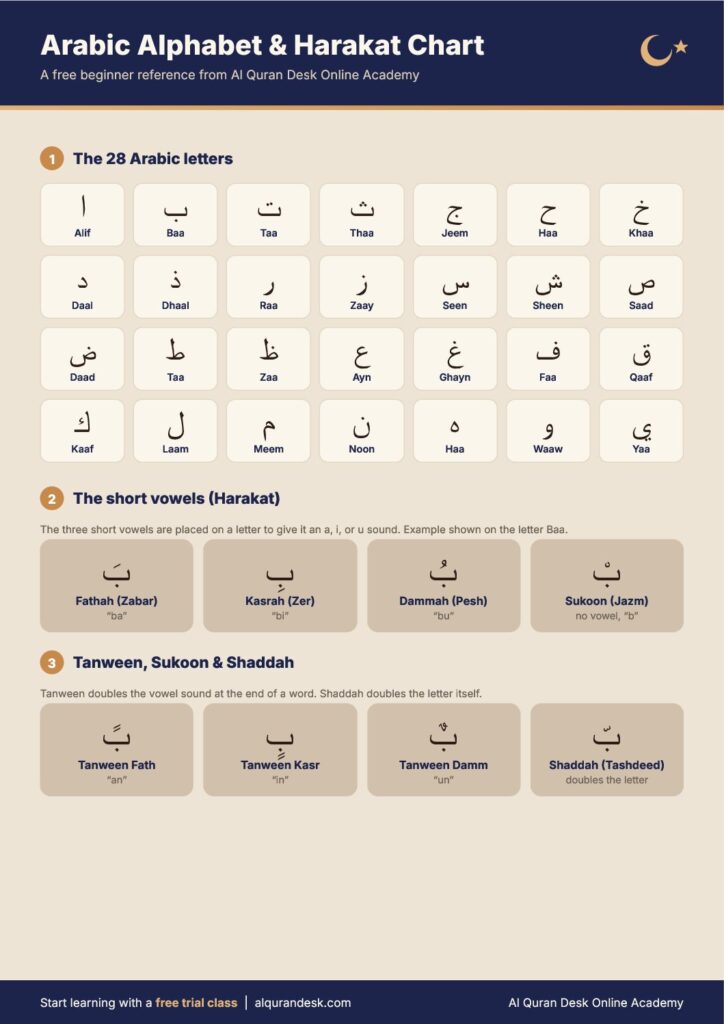
You start with the 28 Arabic letters, known as Huroof e Mufridaat. You learn each letter by name, by shape, and by sound, and you learn the makharij, the points in the mouth and throat where each sound is made. From there you cover the joined and compound letters, Huroof e Murakkabat, and the broken letters that open some Surahs, Huroof e Muqatta’at. You also see how the same letter changes shape at the start, middle, and end of a word.
Stage 2, the short vowels and signs
After the letters, you practise the harakat, the short vowel marks. These are fathah (zabar), kasrah (zer), and dammah (pesh), which give each letter an a, i, or u sound. You then read tanween, the double marks at the end of a word, and the standing vowels, khari harakat, which stretch the sound.
Stage 3, long sounds and silence
Next come the long vowels, madd and the huroof maddah, together with the soft letters, leen. You also learn sukoon, also called jazm, the sign that tells you a letter carries no vowel and the sound stops.
Stage 4, doubling, special letters, and stopping
This stage adds shaddah, also called tashdeed, which doubles a letter, with its many combinations. You cover qalqalah, the letters that carry a light echo, and the rules for noon sakin, meem sakin, and noon qutni, along with the special rules of the letters raa and laam. It ends with waqf, how and where to pause and stop while reading.
Stage 5, reading real Quranic words
In the final lessons you apply everything you have learned. You read full words and short verses from the Quran, with practice exercises after each lesson, until you can read them with confidence. Basic Tajweed runs through the course from the first lesson, so you read accurately, not just quickly.
How do the online Noorani Qaida classes work?
Every class is live and one to one over a video call. Your teacher shares the Qaida page on screen, you read aloud, and the teacher corrects each sound as you go. You pick the days and times that fit your week, and you keep the same teacher, who follows your progress from one lesson to the next. Most students take two or three classes a week, and a few minutes of practice between lessons works far better than long gaps. All you need is a phone, tablet, or computer and an internet connection. Explore our Quran learning programs worldwide
Who are Noorani Qaida classes for?
You do not need any Quran or Arabic reading experience to start. Children can begin from about age four or five, once they can sit and repeat sounds. Adults who never had the chance to learn can start now and go at a calm pace. New Muslims and reverts are welcome, and so are people who do not speak Arabic, because the teacher explains each sound in simple words. Sisters and girls can ask for a female teacher.
Who will teach you?
Your classes are led by qualified male and female Quran teachers from across the Muslim world. They teach the Qaida every day and have worked with many students who are new to Quran reading, so they notice pronunciation mistakes and correct them during the lesson. You can read about our Quran teachers and ask for a male or female teacher when you book. We do not make claims we cannot stand behind, so we tell you plainly who teaches you and how.
Common mistakes beginners make, and how we fix them
Three mistakes slow most new learners down. The first is rushing the harakat, so the short vowels are never solid. The second is reading a word from memory by its shape, instead of sounding out each letter. The third is skipping revision, so earlier lessons fade. Because your class is one to one, your teacher spots these during the lesson and sets the right amount of review, before they turn into habits.
How do you know you are ready for the Quran?
You are ready to move on when you can name the letters and their sounds, read the vowel marks without pausing, and apply the basic stopping rules. At that point your teacher moves you into Quran reading, called Nazra, where you read directly from the Mushaf. Many students then continue to Tajweed and later to Hifz.
How much do classes cost, and is there a free trial?
Classes are billed monthly, and you can see the current plans on our pricing page. Before you pay anything, you can book a free trial class to meet your teacher and see how a lesson feels. The trial needs no card and no payment, so you can watch a real lesson before you choose a monthly plan. There is no free ongoing course, but you can try a lesson first with nothing to pay.
Frequently asked questions
What is Noorani Qaida and why is it important?
It is the first book for learning to read Arabic and the Quran. It teaches the letters, their sounds, and the marks that guide reading, so you learn to read accurately before you start the Quran itself.
Why learn Qaida before reading the Quran?
Arabic sounds and marks change meaning, and many letters are easy to confuse. Learning the Qaida first means you read the Quran accurately instead of guessing.
Do I need to know any Arabic before I start?
No. The course starts from the very first letter and is built for people who do not speak Arabic.
What age can a child start Noorani Qaida?
Most children can start at about four or five, once they can sit and repeat sounds. There is no upper age limit.
Can adults and complete beginners learn it online?
Yes. Many adults begin from zero and do well with short, regular one to one classes.
How long does the Noorani Qaida course take?
It depends on your age and how many classes you take each week. Many students finish in a few months with two or three classes a week.
Does it include Tajweed?
Yes. Basic Tajweed is taught from the first lesson, so your pronunciation is correct as you learn.
Can I request a female teacher for sisters and girls?
Yes. We have qualified female teachers, so sisters and girls can learn with a woman teacher.
How are the online classes run?
Each class is live and one to one over a video call, with the teacher sharing the Qaida on screen and correcting you as you read.
Is there a free trial, and do I need a card?
Yes. You can book one free trial class with no card and no payment, then choose a plan if you wish to continue.
What comes after Noorani Qaida?
Most students move to Quran reading (Nazra), then to Tajweed and, if they wish, Hifz.
Free Arabic alphabet and harakat chart
A clear one page reference with all 28 Arabic letters and their names, plus the harakat, tanween, sukoon and shaddah. Print it and keep it beside you while you practise.
Experience the Holy Quran Difference
“Arise for prayer during the night, except for half of it – or a little more – And recite the Quran in measured tones.” – 73:1-2
We would love to hear from you