
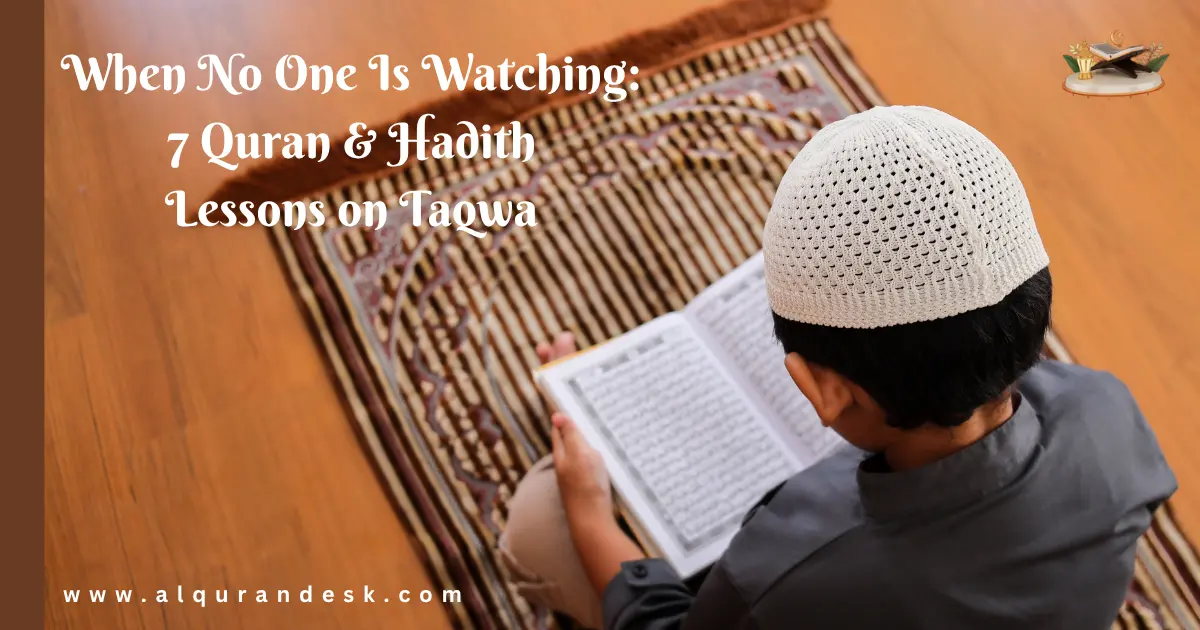
Taqwa in Islam: 7 Powerful Lessons from the Quran and Hadith
What is Taqwa in Islam?
Taqwa in Islam refers to the state of being conscious and mindful of Allah, being aware that Allah knows our thoughts, words and actions, and to do things that are pleasing to Allah and avoid things that Allah has prohibited. Taqwa is translated as God-consciousness, piety or righteousness, and it is not mere fear of Allah, but a way of life that is conducted according to faith, obedience, sincerity, and accountability. Taqwa is mentioned many times in the Qur’an, as it is a characteristic of the character of a believer in his decisions, worship and his relationship with Allah.
Taqwa is the consciousness of Allah and guarding against disobedience by obeying Allah’s commands in an Islamic context. Taqwa is therefore greater than fear. It involves reverence for Allah, obedience to Him, abstinence from sin, remembrance of the afterlife, seeking forgiveness from Him, and an attempt to live in accordance with His commands. A person with Taqwa does not ask – “Will somebody find out?” They ask, “Is Allah pleased with this? This slight shift in mindset could be the difference between a person’s life and how it turns out.
ذٰلِكَ الۡڪِتٰبُ لَا رَيۡبَۛۚۖ فِيۡهِۛۚ هُدًى لِّلۡمُتَّقِيۡنَۙ ٢
This is the Book! There is no doubt about it—a guide for those mindful ˹of Allah˺,
— Dr. Mustafa Khattab, The Clear Quran Al-Baqarah 2:2
Finding a suitable teacher for the Qur’an can sometimes be difficult for Muslims around the world. AlQuranDesk Worldwide offers an online learning opportunity for students who desire to study the Quran at home. Learners can explore programs according to their age, level, and Quran learning goals. Let’s explore 7 lessons from the Quran and authentic Hadith.
When no one is watching, what do you do?
If you don’t have someone to give you feedback, to compliment you, to call you out on your actions, how do you make decisions? Are you willing to be honest when it’s more convenient to lie? Could you not sin if no one were to know? When you are alone, don’t people remember Allah? These secret moments give us a glimpse into Taqwa.
لَنۡ يَّنَالَ اللّٰهَ لُحُـوۡمُهَا وَلَا دِمَآؤُهَا وَلٰـكِنۡ يَّنَالُهُ التَّقۡوٰى مِنۡكُمۡؕ كَذٰلِكَ سَخَّرَهَا لَـكُمۡ لِتُكَبِّرُوا اللّٰهَ عَلٰى مَا هَدٰٮكُمۡؕ وَبَشِّرِ الۡمُحۡسِنِيۡنَ ٣٧
Neither their meat nor blood reaches Allah. Rather, it is your piety that reaches Him. This is how He has subjected them to you so that you may proclaim the greatness of Allah for what He has guided you to, and give good news to the good-doers.
— Dr. Mustafa Khattab, The Clear Quran . Al-Hajj 22:37
Taqwa is a concept of great importance in Islam. It is usually rendered as “the fear of Allah,” “God-consciousness,” “piety,” or “mindfulness of Allah. However, its meaning is more than just fear-based. Taqwa has to do with living in awareness of Allah that affects your choice, action, personality and relation with Allah. In the Quran, taqwa is mentioned several times with instructions to seek it, and it is evident in the Sunnah of Prophet Muhammad s.a.w. as to how taqwa should manifest in daily life.
Lesson 1: Taqwa Begins When You Remember That Allah Sees You
In this lesson, we will learn that getting to know the word ‘Taqwa’ starts with remembering Allah sees you. People can see what we do in public, but not all of what we do in private. But Allah knows what is concealed and what is revealed. This is one of the bases of fear of Allah and Taqwa. When a Muslim is alone, he recalls that Allah is not far.
Consider when no one is present to see your phone, when no one’s tracking on the Internet, and when no one knows what you’re thinking or doing. There’s still a choice out there! It can be done to follow every desire or to recall Allah. One of the practical aspects of Taqwa is that moment of self-restraint.
Allah’s all-knowing is mentioned in the Quran many times. When a person is developing Taqwa, this awareness is a source of accountability, and it will help him make better choices.
اَلَمۡ تَرَ اَنَّ اللّٰهَ يَعۡلَمُ مَا فِى السَّمٰوٰتِ وَمَا فِى الۡاَرۡضِؕ مَا يَكُوۡنُ مِنۡ نَّجۡوٰى ثَلٰثَةٍ اِلَّا هُوَ رَابِعُهُمۡ وَلَا خَمۡسَةٍ اِلَّا هُوَ سَادِسُهُمۡ وَلَاۤ اَدۡنٰى مِنۡ ذٰ لِكَ وَلَاۤ اَكۡثَرَ اِلَّا هُوَ مَعَهُمۡ اَيۡنَ مَا كَانُوۡاۚ ثُمَّ يُنَبِّئُهُمۡ بِمَا عَمِلُوۡا يَوۡمَ الۡقِيٰمَةِ ؕ اِنَّ اللّٰهَ بِكُلِّ شَىۡءٍ عَلِيۡمٌ ٧
Do you not see that Allah knows whatever is in the heavens and whatever is on the earth? If three converse privately, He is their fourth. If five, He is their sixth. Whether fewer or more, He is with them wherever they may be. Then, on the Day of Judgment, He will inform them of what they have done. Surely Allah has ˹perfect˺ knowledge of all things. — Dr. Mustafa Khattab, The Clear Quran— Quran 58:7
Lesson 2: Fear of Allah is More Than Fear of Punishment
When we hear the word fear of Allah it is easy to think of just punishments. But Islam teaches the balance of relationship with Allah. A believer is afraid of Allah and also hopes for Allah’s mercy; a believer loves Allah, trusts in Allah and seeks Allah’s forgiveness.
Allah says:
يٰۤـاَيُّهَا الَّذِيۡنَ اٰمَنُوۡا اتَّقُوا اللّٰهَ حَقَّ تُقٰتِهٖ وَلَا تَمُوۡتُنَّ اِلَّا وَاَنۡـتُمۡ مُّسۡلِمُوۡنَ ١٠٢
O believers! Be mindful of Allah in the way He deserves, and do not die except in ˹a state of full˺ submission ˹to Him˺. — Dr. Mustafa Khattab, The Clear Quran
In this ayah, Taqwa has been explained as a serious condition and to stay committed to Allah. Phobias can keep us from being careless about sin. The way to avoid despair is hope and the way to the nearness of Allah is love. Hence, Taqwa does not mean to live in perpetual despair in Islam. Consciousness of Allah and it affects our lives.
Lesson 3: Taqwa is seen in Your Character
The way an individual should relate to Allah should impact his relationship with other people.
“Surely the most noble of you in the sight of Allah is the most righteous among you. Surely Allah is All-Knowing, All-Aware.”
— Quran 49:13
Taqwa is not all about the duration of our prayers, the amount of Quran we recite, or the knowledge of Islam we have. It also should impact our communication, our demeanor, our interactions, and how we treat others.
The conscience of Allah becomes careful in gossip, backbiting, insults, false accusations and the words that are not necessary for hurting another person.
Narrated Abu Huraira:
The Prophet (ﷺ) said, “Whoever believes in Allah and the Last Day, should not hurt his neighbor and whoever believes in Allah and the Last Day, should serve his guest generously and whoever believes in Allah and the Last Day, should speak what is good or keep silent.” Sahih al-Bukhari 6136
The same goes for online as well. Before commenting, forwarding a message, being angry, etc., a Muslim can ask himself, “Would these words please Allah?” This break may be a moment of Taqwa.
Lesson 4: Taqwa is tested when no one is looking.
Perhaps the strongest query regarding Taqwa is easy: When no one’s looking, who are you? Praise is applicable to public actions. Private actions show what is in our hearts in private.
“Indeed, those in awe of their Lord without seeing Him will have forgiveness and a great reward.”
— Quran 67:12
A teacher could be watching and that person may not cheat. What can be found, however, when the teacher leaves the room? A manager can be there to support the employee, leading to a more honest acting. If they are not being watched, what will happen? The family members may be nearby so that the person does not need to deal with inappropriate content. What happens when they’re left to their own devices?
These moments can be challenges to Taqwa. The issue is not now “Can I get away with this?” So the question is, “Is this pleasing to Allah?” This is why it is important for Muslims to cultivate their God-consciousness, as it helps to change their private behavior.
Lesson 5: Making tough decisions with Taqwa
Each day is filled with decisions. Some are easy and some are temptation, pressure, anger, money, relationship, personal desires. We know what is right, but it is not always easy to make the right decision.
“And whoever is mindful of Allah, He will make a way out for them, and provide for them from sources they could never imagine.”
— Quran 65:2–3
Taqwa gives meaning to these moments on a spiritual level. A believer is not supposed to ask for what is easy or gainful but what is in line with Allah’s guidance. This isn’t the time to make every decision easy to make. It’s more than just personal desire.
Righteousness and success are continuously associated with Taqwa in the Quran. It teaches the Muslims that success does not depend on wealth, education, popularity, or success in their careers or in society. The value of worldly achievements is there but the Quran constantly reminds believers of the hereafter. Taqwa is a reminder to maintain that larger goal.

Lesson 6: Taqwa Does Not Mean You Never Make Mistakes
In lesson 6 we will learn that Taqwa is not about never making mistakes. Another mistake about Taqwa is that a person who has Taqwa will not ever commit a sin. Man is not a perfect being. A believer can get weak, may make a mistake, fall into temptation, or make a bad decision.
“And those who, upon committing an indecency or wronging themselves, remember Allah and seek forgiveness for their sins—and who can forgive sins except Allah?—nor do they knowingly persist in wrongdoing.”
— Quran 3:135
Does the person become comfortable with the sin? Do they justify it? Or do they know their fault and go back to Allah? Taqwa makes a believer want to repent instead of being stuck in sin. Hence, fear of Allah must be coupled with hope of Allah’s mercy, for this is what should always accompany fear of Allah.
Lesson 7: Taqwa Grows Through Quran and Consistent Worship
In lesson 7, you will learn how Taqwa can manifest through the Quran and regular worship. It’s not the norm to form Taqwa out of a single emotional moment. Its growth happens with regular selections. The act of reading the Quran, understanding its meanings, performing the prayer, remembering Allah, offering supplication, seeking His forgiveness and abstaining from bad habits, can all serve as a path to seeking Allah’s Taqwa.
“This is the Book! There is no doubt about it—a guide for those mindful of Allah.”
— Quran 2:2
The Quran is significant because it constantly reminds us of Allah and the Hereafter, and of accountability, of mercy, of worship, and of righteous living. This is the reason why learning the Quran online shouldn’t be just about the lessons. It is to develop a connection with the Quran and grasp what is its direction in life.
Taqwa in your everyday life
Building Taqwa starts with little changes on a regular basis. First, make Allah more aware of you in normal times. Before deciding do you ask yourself if your choice brings you closer to obedience or closer to disobedience?
Read the Quran regularly. It is possible to keep Allah’s guidance in your everyday life by learning regularly even if you don’t have much time. Another key element of this trip is Salah. Make prayer a chance to get closer to Allah all day, instead of just fulfilling a duty.
Dhikr and Istighfar can also be used to maintain the heart of the person towards Allah. Remembrance can help you focus on something else during the day, instead of surrounding stimuli.
Above all, watch your private life. What is assessed is not your Taqwa and what is measured is not what people think of you. It can also be seen in your decision making when nobody is around to cheer you on!
Taqwa in an era of Smart Phones and Social Media
The most challenging test for private behaviour is in the palms of our hands today. A Smartphone can be a means of knowledge and learning of the Quran, Islamic education, communication and helpful knowledge. It can also offer any number of ways to distract and tempt. This makes Taqwa in the digital age more relevant.
- When you’re by yourself, what do you watch?
- What are you looking for?
- Who are your favorite authors?
- What do you comment?
- What do you share?
- How many minutes do you spend per day on scrolling?
Don’t let these questions become reasons for despair. These are chances to reflect and get to know yourself a little better. Taqwa does not imply that Muslims are not allowed to use technology. It refers to remembering Allah when using it. A believer can make a smart phone a place for learning the Quran, getting good reminders, learning hadith, dhikr, and being connected to good Islamic education.
Learn Quran Online Australia provides online Quran lessons for Muslim families in Australia, for children, adults and various levels of learners. Teaching oneself the Quran can be helpful but there are a lot of students who require structure, correction and consistency. Depending on the chosen course, an online Quran tutor can assist a learner in improving his/her pronunciation, Tajweed, reading of the Quran, memorization and understanding.
Taqwa education to Children’s
Parents are interested in their children learning the Quran, however, quran learning should not just be about memorization and recitation. Children can learn gradually that Allah loves them when they are truthful, kind, grateful, patient, worshipful and have good character.
They can be taught that Allah knows what they do, that they pray, and that if they make a mistake, they should repent. Parents are one of the most effective means by which they teach Taqwa to their children. Children observe the tone of voice of parents when they are angry. They listen to adults and observe if they are followed.
They observe the behaviour of family members. They observe if Islamic values are observed only in public or at home as well. Thus, Taqwa is not being taught merely through words. It is likewise learned by example.
Online Quran classes may be helpful to families in areas where they can’t find a local Quran teacher conveniently. AlQuranDesk offers online Quran training for students from all over the world and in various age groups. For busy families, online learning can make it easier to fit in the study of the Quran in a regular family routine.

Conclusion: Qur’anic Arabic vs Modern Arabic
There is a close relationship between Qur’anic Arabic and Modern Standard Arabic, though they are used for different purposes. Qur’anic Arabic is a particular form of Arabic, the language of the Qur’an, which is part of the Classical Arabic tradition. Modern Standard Arabic is the formal variety of Arabic today, which is used in modern writing, to teach Arabic, in the media, and in formal communications.
They share important foundations such as Arabic script, roots, vocabulary, grammar, morphology and sentence structures. Their word meanings, historical backgrounds, literary forms and applications, however, vary. Learning Qur’anic Arabic will help you gain knowledge of the structure and vocabulary of the Qur’anic text if your main objective is to understand the Qur’ān. If you wish to read modern Arabic books, news, academic papers, or official correspondence, then MSA should be included in your course of study.
They need not be mutually exclusive. If you have a solid base in Arabic, you can then go on to study both Classical Arabic (Qur’anic Arabic) and Modern Standard Arabic (MSA). Learning Arabic can be more than an endeavor for Muslims, particularly.
Seven Questions to reflect on Taqwa
Take a few moments to be quiet and think before you finish this article.
- If no one is around, do I remember Allah?
- When tempted to sin, do I think of this: “Allah knows?”
- Are there areas of my life that are affected by my learning of the Quran?
- Do I control my words when I become angry?
- Am I more concerned about people’s opinions than Allah’s pleasure?
- If I make a mistake do I go back to Allah?
- What is one small step that I can take today to enhance my Taqwa?
Don’t make all the changes at one time. Take one good step at a time.
Frequently Asked Questions About Taqwa
What does Taqwa mean in Islam?
Taqwa means awareness of Allah and consciousness that brings a believer to Allah’s obedience, righteousness, averting from sin and consciousness of accountability to Allah.
Are Taqwa and fear of Allah the same?
Fear of Allah is one of the elements of Taqwa, but Taqwa extends beyond that. It contains the knowledge of Allah, love of Allah, reverence of Allah, obedience to Allah, avoidance of sin, repentance, hope and righteous actions.
What does the Quran say about Taqwa?
Taqwa is mentioned many times in the Quran. Allah commands the believers to remember Him (3:102), and to be subservient to Him.
What should I do in order to increase my Taqwa?
Taqwa can be developed through the study and understanding of the Quran, performing Salah, remembering Allah, making duas and Istigfars, avoiding sins, controlling the tongue and remembering the hereafter.
Does someone who has Taqwa never commit sin?
No. Taqwa is not the perfection of mankind. A believer may commit errors, but he should be aware of them, repent of them, seek forgiveness and make an effort to improve his situation.
Conclusion:
Taqwa is not for the purpose of creating an image of righteousness for others. It starts in the heart and is manifested in our actions. Taqwa reminds us when there is no one looking, that Allah is looking. When no one is praising us, Taqwa reminds us of Allah’s knowledge.The Quran reminds us:
“And take provisions, for surely the best provision is righteousness. And be mindful of Me, O people of understanding.”
— Quran 2:197
When temptation comes Taqwa urges us to remember that temporary pleasures cannot be given for the sake of disobeying Allah. And when we make a mistake, Taqwa reminds us to go back to Him.
The path towards Taqwa is not a quick one, it involves a series of steps. It is about being aware of Allah, one verse, one prayer, one moment of self control, one sincere repentance, one private good deed and one step at a time. Now ask yourself once again, So when you’re alone, who are you listening to?
May Allah instill the sincerity of Taqwa into our hearts, may Allah increase our love for the Quran, may Allah forgive our mistakes, may Allah shield us from unseen and seen sins, may Allah guide us to what is good. Ameen.
Connect with a Quran Teacher
Start learning Holy Quran immediately by connecting with a teacher, right now!
We would love to here from you