
Qur’anic Arabic vs Modern Arabic: 5 Essential Differences for Beginners
Qur’anic Arabic vs MSA: What’s the Difference?
When learning Arabic online, particularly with the aim of understanding the Qur’ān, you may have heard Arabic terms like Qur’anic Arabic, Classical Arabic, Modern Standard Arabic (MSA), and spoken Arabic. These terms may be confusing to a beginner. What is the difference between Qur’anic Arabic and Modern Arabic? Is it possible to understand the Qur’an with the knowledge of MSA? Is it advisable for you to learn the Qur’an in Arabic before the Qur’an itself?
Once one recognizes that Arabic has different registers and varieties for different purposes, the answer becomes much more clear. Qur’anic Arabic is the Arabic of the Qur’an, and Modern Standard Arabic is the formal Arabic of the modern world, that is found in modern forms of writing, learning, media and other formal settings. They provide a similar linguistic base but have different vocabulary, style, context and learning goals.
If you’re looking to learn deeper into the Qur’an, grasp Arabic reading better or build a solid Arabic base, practise and learn regularly and you will be able to move forward with confidence. AlQuranDesk Worldwide offers Quran Online Classes, teaching you the Quran and Arabic online anytime and anywhere. Enhance your knowledge of the Quran, Arabic vocabulary, grammar, pronunciation and comprehension, with flexible, online instruction from home.
This guide offers a simple explanation of the difference between Qur’anic Arabic and Modern Arabic, as well as their similarities and differences, and it will assist beginners to determine which of these two is the first Arabic they should learn.
What Is Qur’anic Arabic?
The Arabic of the Qur’an is called Qur’anic Arabic. It is part of a larger Classical Arabic tradition and is recorded in the Qur’anic text for over 1400 years.
Allah makes it clear that the Qur’an is in Arabic. He says:
إِنَّا أَنزَلْنَاهُ قُرْآنًا عَرَبِيًّا لَّعَلَّكُمْ تَعْقِلُونَ
Indeed, We have sent it down as an Arabic Qur’an that you may understand.
Qur’an 12:2
The Qur’an also says that it is revealed in Arabic in a clear manner:
بِلِسَانٍ عَرَبِيٍّ مُّبِينٍ
In Arabic with clarity of language.
Qur’an 26:195
Another verse states:
كِتَابٌ فُصِّلَتْ آيَاتُهُ قُرْآنًا عَرَبِيًّا لِّقَوْمٍ يَعْلَمُونَ
Its verses are beautifully explained; it is a Book in Arabic for people who know; it is a Book whose meaning is perfectly understood.
Qur’an 41:3
These verses prove that the revelation of the Qur’ān is in Arabic. It may thus be possible for a Muslim pupil to make more direct contact with the text of the Qur’an when studying Arabic than by using translation alone.
What Is Modern Standard Arabic?
MSA, or Modern Standard Arabic, is the Arabic that is used in the modern Arab world. The typical contexts for MSA include newspapers, books, educational material, official documents, formal speeches, academic writing, websites and television news. This is not the same as the regional speech used by most people in their casual home speech.
Modern Standard Arabic evolved from Classical Arabic and shares many of its grammatical and morphological elements. New vocabulary and phrases in modern Arabic, however, have grown up around notions that were not present at the time of the Qur’an, such as modern technology, politics, science, transportation, education, and modern institutions.
This is the reason why the study of MSA can make a person learn how to read and understand contemporary Arabic literature, while the study of Qur’an Arabic could concentrate on the vocabulary, grammatical structures and style of the Qur’an itself.
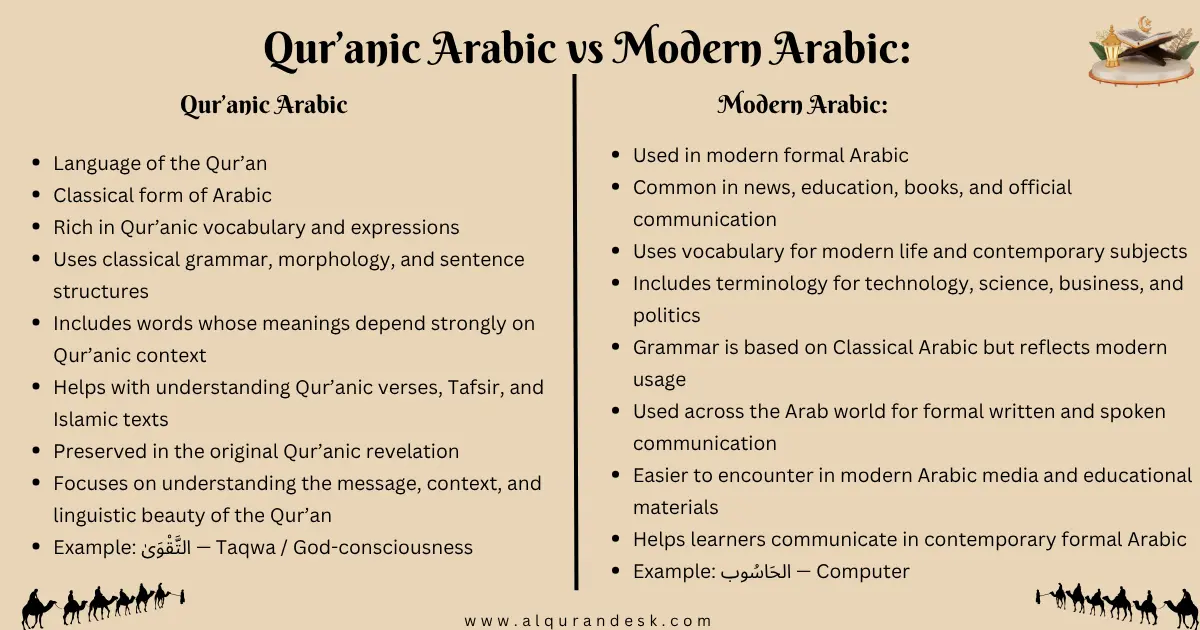
Qur’anic Arabic vs Modern Arabic: Quick Comparison
|
Feature |
Qur’anic Arabic |
Modern Standard Arabic |
|
Main context |
Qur’an and Qur’anic study |
Modern formal communication |
|
Historical setting |
Classical Arabic tradition |
Contemporary Arabic |
|
Main purpose for learners |
Understanding Qur’anic words and structures |
Reading, writing and understanding modern formal Arabic |
|
Vocabulary focus |
Qur’anic and classical vocabulary |
Modern and contemporary vocabulary |
|
Text examples |
Qur’anic verses and classical texts |
News, books, articles, education and formal media |
|
Grammar |
Classical Arabic grammatical system |
Closely related modern formal grammar |
|
Modern terminology |
Limited by the Qur’anic text |
Includes science, technology, politics and modern life |
|
Spoken at home? |
No |
MSA is generally not a home dialect |
|
Best suited to |
Qur’an understanding and Islamic studies |
Modern reading, writing and formal communication |
What is Classical Arabic?
The term Classical Arabic is broader than Qur’anic Arabic. The Arabic of the Qur’an is called Qur’anic Arabic. More broadly, classical Arabic may be used to pertain to the Qur’anic, religious, scholarly, poetic and other historical literature written in literary Arabic of the classical period.
This is important, because a course that is taught as Classical Arabic is not necessarily taught specifically for the purpose of understanding the Qur’an. When searching for a course where your objective is to understand the meaning of the Qur’ān, you should find one that explicitly incorporates the vocabulary of the Qur’ān, Arabic grammar, morphology, the structure of Qur’anic sentences, and practices based on the verses.
1 The Biggest Difference: Vocabulary
One of the most noticeable differences between Qur’anic Arabic and MSA is vocabulary. Words related to the message, the historical background, human nature and actions, worship, morality, nature, hereafter, and other topics touched upon in the revelation are found in the Qur’an.
Meanwhile, modern Standard Arabic has grown its vocabulary to cover the modern world. There are computer, university, medical, economic, transportation, social media, engineering, government, and modern science related words that a learner studying MSA might come across. If an MSA learner is able to recognize the grammar of a Qur’anic verse, but they might face unfamiliar Qur’anic vocabulary, this is what is meant by this.
Likewise, a student who has learned Qur’anic Arabic might know a lot of Arabic roots and learn a lot of grammar, but may not know enough words to read a newspaper or an academic paper. Convenient online lessons for learning Arabic to help you learn Arabic vocabulary, grammar, reading, pronunciation, and comprehension in an easy way with AlQuranDesk.
2 Qur’anic Arabic vs MSA Grammar
The two varieties share a good deal in terms of grammar. Students of Arabic will be exposed to notions of nouns, verbs, pronouns, adjectives, gender, number, verb patterns, prepositions, particles, nominal sentences, verbal sentences, and grammatical relationships in the Qur’anic Arabic as well as MSA.
But there may be structures and stylistic patterns in Qur’anic Arabic that warrant intensive research. The Qur’anic Arabic Corpus is based on traditional Arabic grammar to analyze the structure of Qur’anic verses.
This is why memorizing the translations of Arabic words learned from the Qur’an isn’t sufficient for a learner who seeks to learn more Arabic. Grammar helps to interpret the relationship of words to each other in a sentence.
Knowing a root Arabic word allows you to link the words that are related, but knowing the form, the role of the word in the sentence and its context is essential to understand how it is used in any given verse.
3 The Arabic of the Qur’ān has its own literary style
Style is another consideration that is important. The literary and rhetorical style of the Qur’an is very unique. The wordings, structure, repetition, emphasis, imagery, rhythm and conciseness of its expressions are intrinsic parts of the Arabic text.
Practical contemporary communication is in Modern Standard Arabic. The function of communication is different in a modern news report, academic writing or a government announcement, than the Qur’anic text.
This does not imply that “simple Arabic” is MSA and “difficult Arabic” is Qur’anic Arabic. The difference is best understood through the concepts of historical period, genre, vocabulary, and style.
4 MSA Help You Understand the Qur’an
The study of MSA can be a good basis for learning Arabic from the Qur’ān. Many concepts that are found in the Qur’an are also found in MSA, making the study of MSA an introduction to many concepts for those who study it.
But MSA should not be used as a standalone alternative to the study of Qur’anic Arabic. A learner who is familiar with MSA might still have to learn the specific vocabulary, expressions, morphology, syntax and literary style of Qur’an recitations. It is thus better viewed as a shared relationship, rather than an identity.
5 Qur’anic Arabic Help You Learn MSA
The learner who learns Qur’anic Arabic gains valuable skills in reading Arabic, acquiring word meanings, knowledge of Arabic grammar, morphology, roots and sentence patterns. Later these skills can assist with the learning of MSA. But if someone wants to read contemporary Arabic newspapers, study, websites, or professional documents, he/she needs to broaden their vocabulary to the topics of modern times.
If people learn Arabic Qur’anic vocabulary in subjects related to knowledge, people, nature, worship, morality, etc., they will not necessarily learn the vocabulary related to the field of biotechnology, artificial intelligence, economics, modern education, etc. It’s the foundations that get transferred, but the vocabulary must grow.
A Beginner’s Guide to Learning Arabic:
For the Beginner’s, there is no need to learn everything quickly. Learn the Arabic alphabet and pronunciation. Develop confidence to read Arabic words before learning more advanced grammar. Then learn simple words, pronouns, simple sentence patterns and learn some simple grammar. Students may start to identify familiar Arabic word patterns and roots at this point.
The next phase can be introducing high frequency words from the Qur’ān, short surahs, common grammatical patterns, and word-by-word analysis for the learner with a focus on the Qur’ān. The same foundation can be enhanced with current vocabulary, reading texts, formal writing, and current Arabic texts for an MSA focused learner.
As you become more proficient, you can start to learn Arabic morphology, higher level grammar, longer texts, and more complex sentence structures. AlQuranDesk is a great option for Quran Classes in Australia which students can benefit from at the comfort of their homes. Online Quran lessons are available to learners in Australia and other countries which provide flexible learning opportunities to acquire the knowledge of Quran, Tajweed, Arabic and Islamic knowledge and improve in the reading of Quran.
Qur’anic Arabic vs MSA: Key Differences at a Glance
The most significant distinction is for purpose. In Qur’anic Arabic, students learn the Arabic language of the Qur’an and classical context of its language. MSA is a course in modern literary Arabic.
The second difference is that of vocabulary. Qur’anic Arabic has vocabulary and expressions that are specific to the Qur’anic text and classical tradition, and MSA has new words for the new topics.
The third difference is with regards to style and genre. The writing style of the Qur’an is unique in both literary form and rhetorical style, while MSA is used in a variety of modern genres, including journalism, education, formal communication and academic writing.
The fourth difference is your learning objective. A student of Qur’anic Arabic is likely to wish to have more access to the text of the Qur’ān, and the student of MSA may wish to have more access to modern Arabic reading, writing, and formal communication skills.
Frequently Asked Questions
What is the difference between Qur’anic Arabic and Modern Standard Arabic?
While they are closely related, there are significant grammatical and vocabulary ties between them, but Qur’anic Arabic is part of Classical Arabic tradition and MSA is the modern formal tradition.
Is it the same Arabic that is used in the Qur’ān (quran) as Classical Arabic?
Classical Arabic is a part of the Qur’anic Arabic tradition. Classical Arabic, however, is a wider term that encompasses other classical literary, scholarly and historical texts.
Is it possible to comprehend the Qur’an when I study MSA?There is a lot of overlap in grammar, morphology, roots, and words, which means you will get a great head start with learning MSA. Nevertheless, there may be the need for focused Qur’anic study of Qur’anic vocabulary, structures, and style using Qur’anic Arabic.
What should I do in order to learn Arabic for the Qur’an or MSA first?
Make selection based on the objective. If your objective is to understand the Qur’an, then start with Qur’anic Arabic. If you want to be able to read and write formally in a contemporary genre, MSA might be more relevant. If you desire both, you can study them sequentially.
Conclusion: Qur’anic Arabic vs Modern Arabic
There is a close relationship between Qur’anic Arabic and Modern Standard Arabic, though they are used for different purposes. Qur’anic Arabic is a particular form of Arabic, the language of the Qur’an, which is part of the Classical Arabic tradition. Modern Standard Arabic is the formal variety of Arabic today, which is used in modern writing, to teach Arabic, in the media, and in formal communications.
They share important foundations such as Arabic script, roots, vocabulary, grammar, morphology and sentence structures. Their word meanings, historical backgrounds, literary forms and applications, however, vary. Learning Qur’anic Arabic will help you gain knowledge of the structure and vocabulary of the Qur’anic text if your main objective is to understand the Qur’ān. If you wish to read modern Arabic books, news, academic papers, or official correspondence, then MSA should be included in your course of study.
They need not be mutually exclusive. If you have a solid base in Arabic, you can then go on to study both Classical Arabic (Qur’anic Arabic) and Modern Standard Arabic (MSA). Learning Arabic can be more than an endeavor for Muslims, particularly.
Learn Arabic with AlQuranDesk Online:
You can learn step by step with online guidance, from the basics to understanding the Qur’an, in everyday Arabic, or to improve your overall language skills. Learn Arabic Language Online with an Alquran desk.
AlQuranDesk provides online Arabic lessons to students of various ages and levels. Step up your Arabic skills with vocabulary, grammar, reading, pronunciation and comprehension.
Try a free trial and find out how you can fit online Arabic lessons into your schedule. Sign up for a free trial now and embark on Learn Arabic Language Online journey using AlQuranDesk.
Connect with a Quran Teacher
Start learning Holy Quran immediately by connecting with a teacher, right now!
We would love to here from you