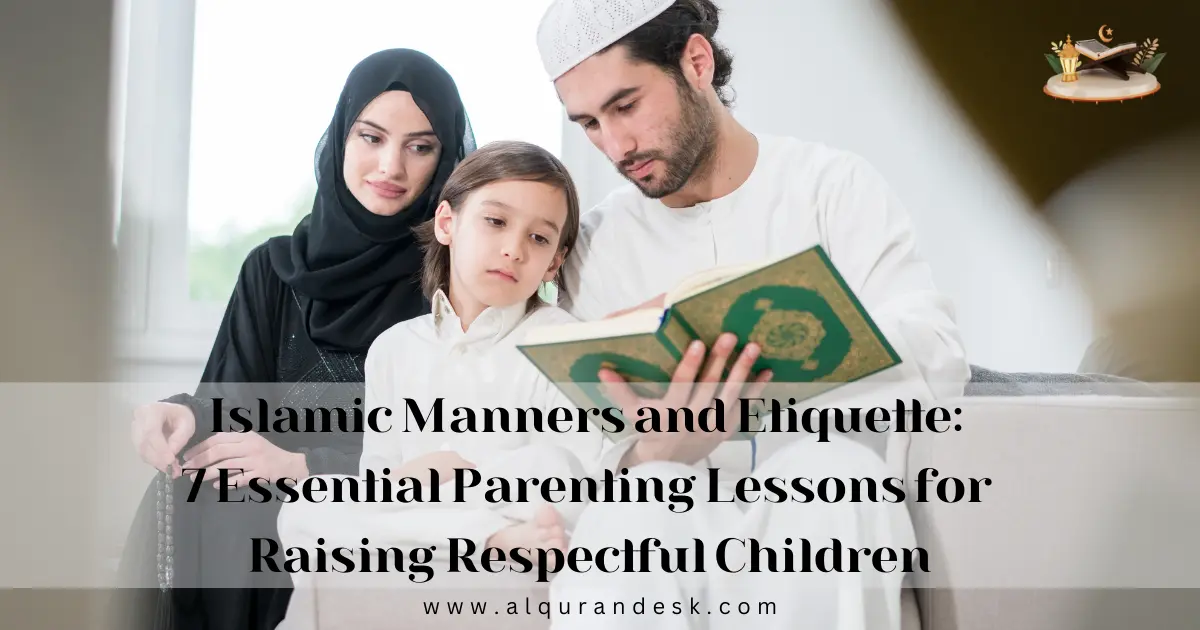
Islamic Manners and Etiquette: 7 Essential Parenting Lessons for Raising Respectful Children
Introduction
One of the most important roles that Muslim parents are assigned is to bring up children who have high Islamic manners and etiquette. In Islam, good behaviour is not a form of social politeness; this is because it is an act of worship which is related to faith (Iman). Educating children on the importance of good etiquette, as it is described within the Islamic framework, is an important tool that can make children realise that their actions not only have an impact on the community, but also on Allah.
Islam does not just teach about the need to feed, shelter and give education to their parenting but to nurture character (Akhlaq). Intense Islamic upbringing shapes the children to be respectful, emotionally intelligent, spiritually oriented, and socially accountable.
As per research studies on child development in the world, early training of character is a major determinant of how an adult person behaves. According to the research released by the Center on the Developing Child of Harvard, emotional regulation and moral guidance during early childhood play a very strong role in success and stability of relationships in mature age. The doctrine of Islam was being underlined by the Quran and the Sunnah of Prophet Muhammad more than 1,400 years ago with the teachings of Quran and the Sunnah of Prophet Muhammad (Salla Llahu Alayhi WaSallam).
Prophet Muhammad {Salla Llahu Alayhi WaSallam} is the best of noble character. Allah says in the Qur’an:
And a great moral character you are, indeed. (Qur’an 68:4)
Akhlak, or Islamic character building, starts at home. By teaching the manners based on the Quran and Sunnah, parents are moulding future leaders, caring neighbours and responsible believers. Here with Alqurandessk online worldwide, we discuss 7 fundamental lessons of Islamic etiquette and manners that can help to raise respectful children.
The Reason as to why Islamic Manners and Etiquette Matter in Childhood
Parenting the child through observation and repetition helps children learn behaviour. Islam acknowledges this and stresses parental responsibility.
The Prophet {Silla Llahu Alayhi WaSallam} said:
“Each of you is a shepherd, and each of you is a guardian to his flock. The first one is related as (Sahih al-Bukhari 893; Sahih Muslim 1829).
Islam has a direct relationship between manners and faith. The Prophet [Silla Llahu Alayhi WaSallam] also said:
The best of the believers of faith are the most perfect of character. (Sunan Abi Dawood 4682 – Hasan Sahih)
The beginning of the journey in Islam is a beautiful, life-changing step. It would make all the difference whether you are new to the Islamic faith or are considering it seriously; having a systematic orientation is the key.
The New Muslim Course Online provided at AlQuranDesk is well crafted to help kids, beginners and converts by being easy to understand, empathetic and genuine. And in case you want a program that is trustworthy and can help you, you can investigate the New Muslim Course Online among Converts.
Benefits of teaching children the Islamic etiquette:
Parenting children according to Islamic etiquette helps in:
Strengthens their Iman
Develops humiliation and discipline.
Encourages empathy
Creates harmony in families
Guard against any influence that is negative.
Islam does not allow good character to be an option; it is a part of religious identity.
Lesson 1: Welcome people with Salam
One of the first Islamic etiquette, parenting lessons is teaching children to greet others with:
Spreading Peace and Love, The greeting is one of the loveliest of the Islamic manners:
Assalamu Alaikum – Peace to thee.
Response: Wa Alaikum Assalam. To you be peace
The Spiritual Importance of Salam.
Allah says:
“And when you are greeted with a greeting, greet with better than it or return it equally.” (Qur’an 4:86)
Peace greeting creates unity and brotherhood. The Prophet said, {Silla Llahu Alayhi WaSallam}:
None will enter Paradise until he believes, none will love one another until he believes. Will I not say to you something that by doing it, you shall love each other? Diffuse Salam unto one another. (Sahih Muslim 54)
The teaching of children, Salam links them to the rest of the Muslim community.
Teaching Salam to Kids
Make children welcome members of the family each morning.
Train them to meet the seniors first.
Greetings, role-playing at home.
Compliment them when they take the initiative of Salam.
The Prophet {Silla Llahu Alayhi WaSallam} said:
“You will not enter Paradise until you believe… Spread Salam among yourselves.” (Sahih Muslim 54)
This parenting lesson develops the sense of humility and social awareness.
Lesson 2: Honouring the parents – An Islamic value.
Islamic parenting etiquette and manners revolve around respect for parents. Islamic parenting is based on honouring the parents.
Allah Says:
“And your Lord has decreed that you worship none but Him, and to parents, good treatment.” (Qur’an 17:23)
The Prophet ﷺ said:
“The pleasure of Allah lies in the pleasure of the parents.” (Sunan al-Tirmidhi 1899 – Hasan Sahih)
However, see how the kindness to parents is stated after worshipping Allah.
Real-life tips on how to teach disrespect towards parents.
Train children to speak in a low voice.
Promote assistance with home chores.
Etiquettes (such as Pleases and JazakAllah Khairan), which are polite expressions, need to be taught.
Exercise patience when in disputes.
Respectful conversation in a role-playing helps children to learn how to speak and behave.
Lesson 3: The respect towards the Elders and Teachers.
The Muslim religion is a strong believer in respect for elders and scholars. Islamic parenting is based on respect.
The Prophet {Silla Llahu Alayhi WaSallam} said:
“He is not one of us who does not show mercy to our young and respect to our elders.” (Sunan al-Tirmidhi 1919 – Hasan Sahih)
Teaching children to:
Offer seats to the elders
Active listening, no interruption.
Greet elders first
Assist elderly relatives
develops humility and compassion.
Respect for Teachers
In Islam, teachers are respected since knowledge is sacred.
The Prophet said, {Silla Llahu Alayhi WaSallam}:
The Prophet ﷺ said:
“The scholars are the heirs of the Prophets.” (Sunan Abi Dawood 3641 – Sahih)
Encourage children to:
Pay attention in class
Never argue unpleasantly.
Express gratitude
Parents may use classroom situations to rehearse any respectful reaction.
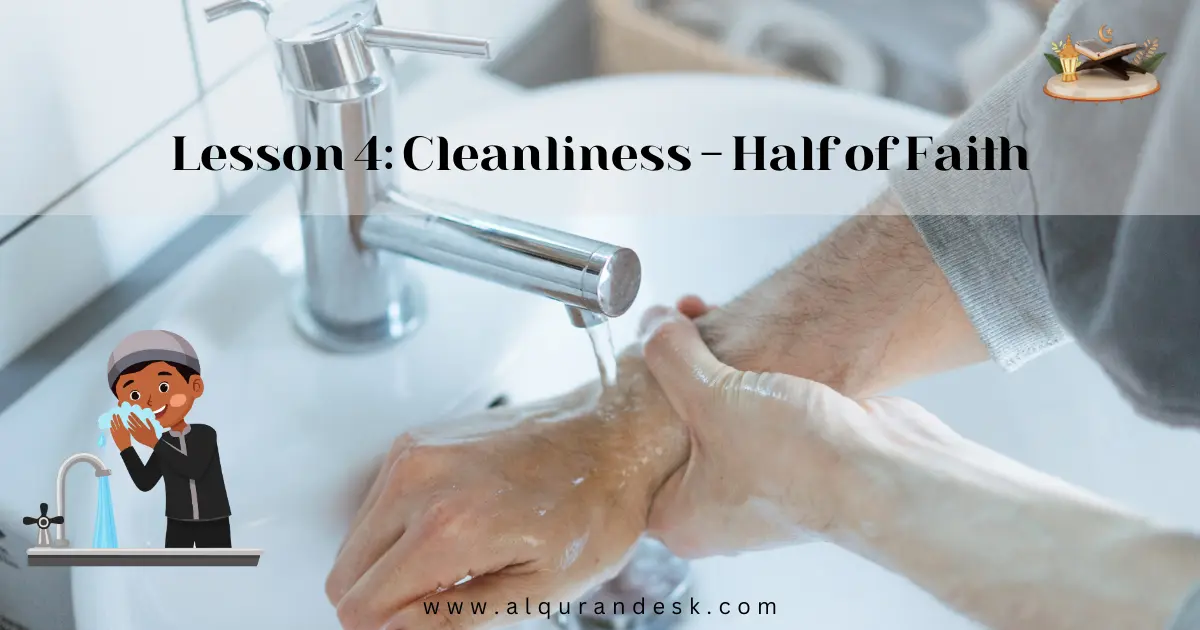
Lesson 4: Cleanliness – Half of Faith
One of the characteristics of Islamic etiquette is cleanliness.
The Prophet, {Silla Llahu Alayhi WaSallam} said:
“Purification is half of faith.” (Sahih Muslim 223)
Hygiene among children should be taught at an early age, and this instils discipline and self-respect.
The Islamic parenting involves training the children to:
Perform wudu properly
Maintain clean clothes
Keep their rooms tidy
Care for their environment
Perform Wudu properly
Wash your hands before taking food.
Brush teeth regularly
Trim nails
The Prophet {Silla Llahu Alayhi WaSallam} stressed oral hygiene:
“If it were not that I would cause hardship for my Ummah, I would have ordered them to use the siwak before every prayer.” (Sahih al-Bukhari 887; Sahih Muslim 252)
Eco-Friendly Clothing and Environment
Allah says:
“And purify your garments.” (Qur’an 74:4)
Children should learn:
Wearing clean clothes
Keeping their rooms tidy
Throwing trash properly
The Prophet {Silla Llahu Alayhi WaSallam} said:
“Removing harm from the road is charity.” (Sahih Muslim 1009)
Cleanliness teaches us to be responsible for society.
Lesson 5: Talking nicely and telling the truth.
Speech reflects character.
Allah says:
And good words say to people. (Qur’an 2:83)
The Islamic parenting teach children to avoid:
Lying
Backbiting
Mocking
Harsh language
The Importance of Honesty
The Prophet {Silla Llahu Alayhi WaSallam} said:
“Truthfulness leads to righteousness, and righteousness leads to Paradise.” (Sahih al-Bukhari 6094; Sahih Muslim 2607)
Encourage honesty in terms of reward, even in cases of mistakes.
Lesson 6: Islamic Dining Etiquette
Islam also provides an answer even in matters of eating etiquette.
The Prophet {Silla Llahu Alayhi WaSallam} schooled a small boy:
“O young boy, say the name of Allah, eat with your right hand, and eat from what is near you.” (Sahih al-Bukhari 5376; Sahih Muslim 2022)
The Islamic parenting involves training the children to:
Say “Bismillah” before eating
Eat with the right hand
Avoid wasting food
Share with others
These little habits develop discipline and gratitude.
Lesson 7: Learning to Control Anger and be Patient
A strong person is one who is able to control his/her emotions.
The Prophet {Silla Llahu Alayhi WaSallam) said:
“The strong person is not the one who overcomes others by strength, but the one who controls himself while in anger.” (Sahih al-Bukhari 6114; Sahih Muslim 2609)
The Islamic parenting involves training the children to:
Pause before reacting
Seek refuge in Allah
Practice deep breathing
Walk away from conflict
Patience develops maturity and self-control.
Practical ways of the Islamic Manners teaching.
Lead by Example
Children imitate parents. Demonstrate compassion, tolerance and dignity.
Aisha, the wife of the Prophet, said: of the Prophet, the messenger of God, Salla Llahu Alayhi WaSallam:
His personality was the Quran.
Use Stories from the Seerah
Fiction based on kindness, forgiveness and mercy has an emotional appeal to children.
Positive Reinforcement
Show praise because of good behaviour.
Shyness in spanking: not being used, better to correct gently.
Consistency and Routine
Manners are a habit, and they are acquired by repetition daily.
Islamic etiquette is the way of practising.
Long-term Advantages of Preaching Islamic Manners and Etiquette.
In the case of children being brought up in Islamic manners:
They develop a good Muslim identity.
They acquire emotional intelligence.
They earn a reward from Allah
They have a positive impact on society.
Psychological and Social Effects
Islamic etiquette builds:
Emotional regulation
Self-discipline
Social intelligence
Leadership traits
In contemporary psychology, this is validated by the fact that early moral training determines life behaviour (Islam had laid down 1400 years ago).
Modern developmental science confirms principles deeply embedded in Islam:
| Islamic Principle | Psychological Benefit |
|---|---|
| Patience (Sabr) | Emotional regulation |
| Gratitude (Shukr) | Increased happiness |
| Respect for elders | Social stability |
| Cleanliness | Health & discipline |
| Forgiveness | Reduced stress |
| Structured routine (Salah) | Cognitive discipline |
Islamic parenting aligns naturally with evidence-based developmental psychology.
The Long-Term Parenting Impact of Islamic Manners
Children brought up in Islamic ways are likely to develop:
Higher empathy levels Stronger moral reasoning, and etiquette-level communication skills.
Emotional stability
Leadership qualities
Character education helps to decrease juvenile delinquency and enhance community relationships
. Islam does not monothete faith and behaviour.
Manners are worship.
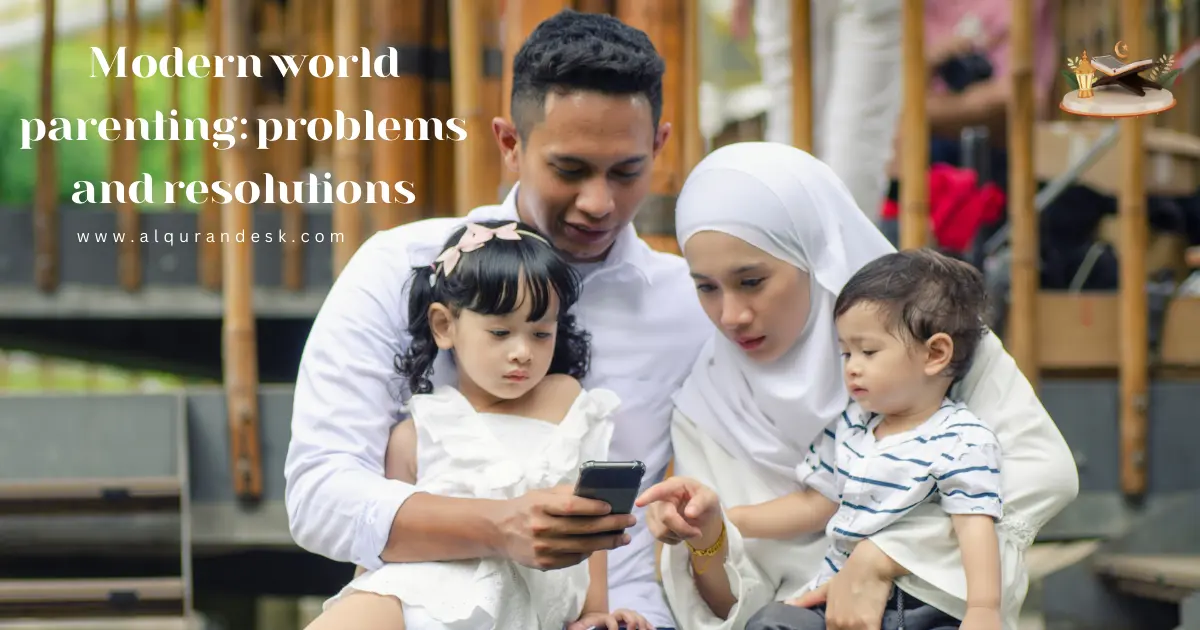
Modern world parenting: problems and resolutions
Today’s parents face:
Digital distractions
Peer pressure
Social media influence
Cultural confusion
Islamic parenting is stable as it offers:
Clear moral guidelines
Consistent routines
Community belonging
Spiritual grounding
Children require order and care, which is taught by Islam.
Parenting Is a Trust (Amanah).
Rearing of children is an Amanah (trust) of Allah.
To raise respectful children, one needs:
Patience
Consistency
Conclusion: Making a Generation
A strong Muslim personality is based on parenting Islamic manners and etiquette. Educating children in Salam, respect, cleanliness, honesty, patience and thankfulness determines their dunya and their akhirah.
The Prophet’s mission was closely related to character. He said:
I was sent to make a perfect good character. (Musnad Ahmad 8952 – Sahih)
It is by imparting these seven imperative lessons that parents are raising children with a prophetic nature in their homes, schools, and communities.
The Islamic cultures and etiquettes are not traditions but Godly directions in shaping well-rounded people and establishments. May Allah bestow wisdom, patience and prosperity to parents when it comes to bringing up right children.
And may Allah bestow upon us the power to bring up pious, caring, and just children who reflect the Islamic ways and etiquette in all spheres of life. Ameen.
FAQ’s Section
Q1: What is the significance of teaching Islamic manners to children?
The Islamic manners not only make a child characterful, enhance faith, but also impart responsibility to Allah and society.
Q2: What can the parents do to teach the Salam to children?
Through modelling it on day by day basis, role-playing greetings, and elaboration of its spiritual rewards based on correct hadith.
Q3: What is the Islamic view regarding parents’ respect?
The Quran mandates good treatment of parents just after the worship of Allah (Quran 17: 23).
Q4: Does Islamic faith include cleanliness?
Yes. The Prophet told Ridi, two half said, purification is half of faith. (Sahih Muslim 223)
Q5: What was the teaching of Prophet Muhammad {Salla Llahu Alayhi WaSallam} on good character?
I went to a perfect good character, he said. (Musnad Ahmad 8952 – Sahih)
Learn Nazra Online
One of the most crucial initial stages in Islamic education is learning Nazra (the basic Qur’an recitation by reading it directly in the Mushaf). It does not merely mean pronunciation, but it means building discipline, respect and spirituality.
In the AlQuranDesk, the Learn Nazra Online program assists students in reading the Quran fluently with an excellent guide and Tajweed principles.
Connect with a Quran Teacher
Start learning Holy Quran immediately by connecting with a teacher, right now!
We would love to here from you