20 Benefits You’ll See by Memorising the Quran Transform Your...
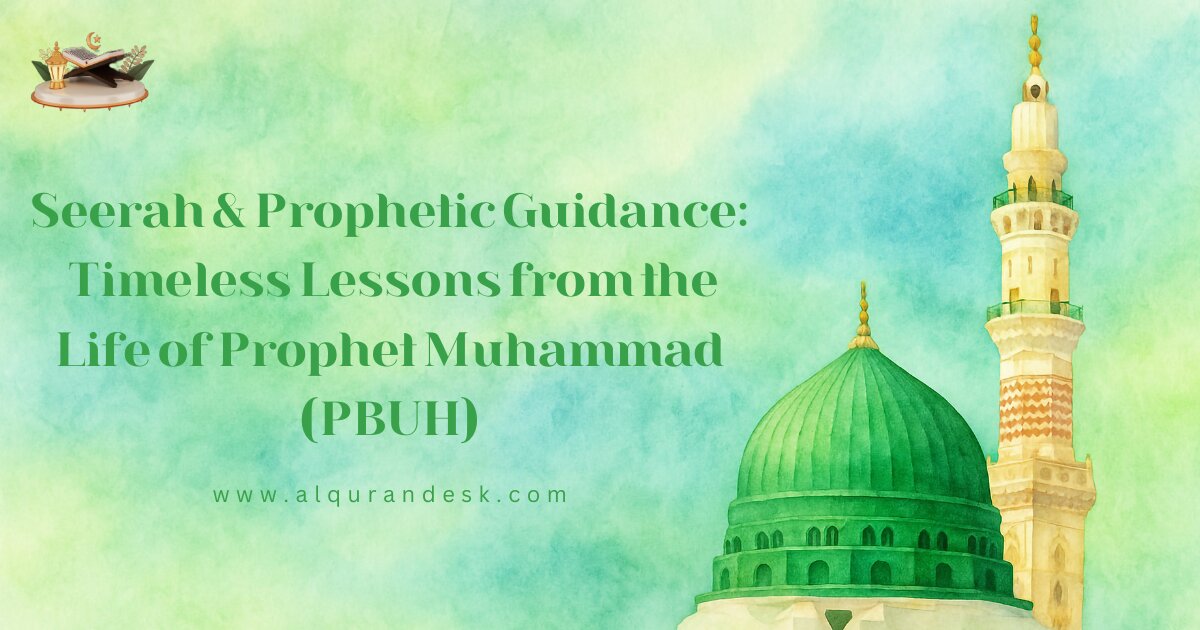
Living in the world of great change, moral disorientation, and unceasing stress, humanity still seeks an authentic, balanced and realistic guidance. The Seerah of Prophet Muhammad (Peace Be Upon Him) is a complete and timeless model for personal character, leadership, social concord, and spiritual prosperity. The Seerah is not just a historical narration but a living manual which implies all aspects of life: faith, family, ethics, governance, patience, and kindness. Allah Himself declares:
“Indeed, in the Messenger of Allah you have an excellent example for whoever hopes in Allah and the Last Day and remembers Allah often.” (Qur’an 33:21)
Learn Quran Online Worldwide with Certified Tutors. This blogpost with Alquran desk online will look into the life of Prophet Muhammad (PBUH), his incomparable personality, and the motivating role model of his companions.
Prophet Muhammad (PBUH) was born in 570 CE in Makkah in a noble tribe of Quraysh. Having been orphaned at a tender age, he had to endure a difficult life; however, these challenges made him kinder, stronger, and more understanding of the helpless.
He was so universally infamous a prophet even before the prophethood that he was commonly referred to as Al-Ameen (the Trustworthy) and As-Sadiq (the Truthful). His integrity in business, justice in conflicts and goodwill in interpersonal relationships made him honourable and respected by all social boundaries.
Lesson for Today
Character is constructed preceding authority.
The key to influence is integrity.
Reliability is achieved by being truthful.
Prophet Muhammad (PBUH) was 40 years old when he was first made to receive the first revelation in Hira Cave:
“Read in the name of your Lord who created…” (Qur’an 96:1)
This was the start of a mission of Tawheed (Oneness of Allah), moral reformation and social justice. His message was a challenge against idol worship, tribal arrogance, and economic price.
The Prophet (PBUH) stood his ground despite the intense resistance, scorn and oppression and instead of striking back, he preferred to be patient and to use wisdom rather than anger.
Lesson for Today
The truth is usually met with opposition.
Being patient is never a weakness.
Change starts with belief and values.
In the Quran, Allah explains the character of the Prophet:
“And indeed, you are upon an عظیم (exalted) character.” (Qur’an 68:4)
The Prophet (PBUH) was an embodiment of mercy to the Muslim and all humankind.
He forgave the people of Taif after being stoned.
He was generous to children, women, slaves and even animals.
He also prayed for guidance on his enemies rather than cursing them.
“The merciful are shown mercy by the Most Merciful.” (Tirmidhi)
Although she was the leader of a nation, the Prophet (PBUH):
Mended his own clothes
Sat with the poor
Ate simple food
And was never in pursuit of luxury or status.
Another principle of his leadership was justice. He declared:
“If Fatimah, the daughter of Muhammad, were to steal, I would cut off her hand.” (Bukhari)
This confirmed the fact that there is no superiority of the law under Islam.
Prophet Muhammad (PBUH) was an excellent husband, father and grandfather.
He assisted in domestic duties.
He was an attentive listener to his wives.
He expressed love openly
He was tolerant in conflicts.
The best of you are the best to your families, and I am the best to my family. (Tirmidhi)
Emotional intelligence is Sunnah.
True character is defined by kindness at home.
The leadership process starts in the family.
Makkah to Madinah migration (Hijrah) was not a runaway act, but rather a calculated move. In Madinah, the Prophet (PBUH):
Founded the original Islamic state.
Constructed Masjid E Nabwi as a social and spiritual place.
Wrote the Charter of Madinah, which guaranteed religious freedom and justice.
Planning and sacrifice are necessities of change.
Communities are empowered through unity.
Under justice, diversity can coexist.
Seerah Leadership and Governance.
Prophet Muhammad (PBUH) was a visionary leader and a model leader.
Consultation (Shura)
Accountability
Mercy with firmness
Clarity of purpose
He was never a ruler by force but by love, trust and moral authority.
The Conquest of Makkah was one of the strongest events in the history of Islam. The Prophet (PBUH) had won after years of persecution, but he did not seek revenge; he said:
“Go, for you are free.”
Lesson for Today
Through mercy, power is tried.
The real victory is a moral victory.
According to the majority of Hadith scholars (Muhaddithin), including Imam al-Bukhari, Imam Ahmad, and Ibn Hajar al-Asqalani, a Sahabi (Companion) is:
“One who met the Prophet Muhammad ﷺ while believing in him and died upon Islam.”
— Ibn Hajar, Al-Isabah fi Tamyiz al-Sahabah
Allah says:
“And the first forerunners among the Muhajirun and the Ansar and those who followed them with excellence—Allah is pleased with them and they are pleased with Him.” Qur’an 9:100
The Sahabah (رضي الله عنهم) played a foundational role in:
Preserving and transmitting the Qur’an
Narrating and safeguarding Hadith
Establishing Islamic governance
Conveying Islam to future generations
Practically implementing the Sunnah
The Prophet ﷺ said:
“The best of people are my generation, then those who come after them, then those who come after them.” Sahih al-Bukhari, Hadith 3651
The first four Caliphs are unanimously regarded as the greatest Sahabah after the Prophet:
Abu Bakr as-Siddiq (RA) – the closest companion and first Caliph
Umar ibn al-Khattab (RA) – known for justice and strength
Uthman ibn Affan (RA) – compiler of the Qur’an
Ali ibn Abi Talib (RA) – known for knowledge and courage
The Prophet ﷺ said:
“You must follow my Sunnah and the Sunnah of the Rightly Guided Caliphs after me.” Sunan Abi Dawood, Hadith 4607 – Sahih
The Prophet ﷺ explicitly named ten companions who were promised Jannah in their lifetime:
“Abu Bakr is in Paradise, Umar is in Paradise, Uthman is in Paradise, Ali is in Paradise…”
Jami‘ at-Tirmidhi, Hadith 3747 – Hasan Sahih
The Ten Are:
Abu Bakr ibn Abi Quhafah
Umar ibn al-Khattab
Uthman ibn Affan
Ali ibn Abi Talib
Talhah ibn Ubaydullah
Zubayr ibn al-Awwam
Abd al-Rahman ibn Awf
Sa‘d ibn Abi Waqqas
Sa‘id ibn Zayd
Abu Ubaydah ibn al-Jarrah
They were the believers who migrated from Makkah to Madinah, sacrificing wealth, homes, and families.
Allah praises them:
“For the poor emigrants who were expelled from their homes and properties…” Qur’an 59:8
The Ansar were the people of Madinah who welcomed, protected, and supported the Prophet ﷺ and the Muhajirun.
Allah says:
“And those who gave shelter and aided – it is they who are the true believers.” Qur’an 8:74
The Prophet ﷺ said:
“Love for the Ansar is a sign of faith.” Sahih al-Bukhari, Hadith 17
The wives of Prophet Muhammad ﷺ hold a unique and honoured status in Islam. They are known as Ummhat-ul-Mu’minin (Mothers of the Believers)—a title granted directly by Allah in the Qur’an. They were not only the Prophet’s wives but also teachers, jurists, role models, and preservers of Sunnah.
Allah says:
“The Prophet is closer to the believers than their own selves, and his wives are their mothers.” Qur’an 33:6
Allah elevated their rank above all believing women:
“O wives of the Prophet, you are not like anyone among women, if you fear Allah.” Qur’an 33:32
The Prophet ﷺ married eleven women, and nine were alive at the time of his death.
All of them are Sahabiyyat and Ummahat-ul-Mu’minin.
The wives of Prophet Muhammad (peace and blessings be upon him) are:
May Allah be pleased with them all. Ameen
The principles left by the Prophet (PBUH) in his Farewell Sermon are still revolutionary:
Equality of all races
The rights of women
Sacredness of life and property.
Responsibility to Allah.
No Arab is better than a non-Arab, no non-Arab is better than an Arab
The Seerah can provide a directive to:
Mental peace
Ethical leadership
Social justice
Family harmony
Interfaith coexistence
We are living in an anxious, material world, and the life of Prophet Muhammad (PBUH) reminds us that the balance between Dunya and Akhirah is what leads to true success.
The study of the Seerah does not involve admiration but implementation. Each part of the life of the Prophet is a lesson that should be learned. Through embracing his forgiveness, sincerity, patience and faith, individuals will be able to change themselves, families can achieve peace, and societies will restore justice.
“And whoever relies upon Allah – then He is sufficient for him.” (Qur’an 65:3)
The Seerah has exhibited total Tawakkul, particularly in the Hijra,h when the Prophet (PBUH) gave the assurance to Abu Bakr (RA):
“Do not grieve; indeed Allah is with us.” (Qur’an 9:40)
The Dawah of the Prophet was comprised of wisdom, patience, and emotional intelligence:
Invite to the way of thy Lord with wisdom and good teaching. (Qur’an 16:125)
He has adapted his message to the audience, such as Quraysh leaders, Bedouin, women and children. He was confident, diplomatic and clear in his faith as seen in his letters to rulers around the world (Bukhari).
Aisha (RA) wrote about the Prophet (PBUH):
His personality was the Quran. (Sahih Muslim)
Some of the core attributes that are highlighted in Hadith literature are the truthfulness (Sidq), trustworthiness (Amanah), patience (Sabr), gratitude (Shukr) and forgiveness.
The Prophet (PBUH) made the exploitation illegal:
As long as the seller and buyer have not parted with the goods, they have the right to keep or give them back. (Bukhari, Muslim)
He denounced hoarding, fraud, interest (Riba), and lies, and established the principles of an ethical economy.
The Prophet (PBUH) contributed to raising the status of women in a society that used to bury daughters:
“The most complete of the believers in faith are those with the best character, and the best of you are best to their women.” (Tirmidhi)
He has focused on education, women’s consent in a marriage, rights of inheritance, and women’s dignity.
The Treaty of Hudaybiyyah is visionary and tolerant. And though this may not appear pleasant, Allah said:
Well, yes, we have done you a good drubbing. (Qur’an 48:1)
This experience teaches us to be strategic in waiting, to be visionary and to trust in the wisdom of God.
The Prophet (PBUH) had prohibited animal cruelty:
One of the women went to Hell because of keeping a cat inside. (Bukhari)
He advocated environmental awareness even in war, not destroying crops and trees (Musnad Ahmad).
Even in the initial revelation, there was a focus on knowledge:
“Read in the name of your Lord…” (Qur’an 96:1)
The Prophet (PBUH) declared:
Learning is compulsory for all Muslims. (Ibn Majah)
Masjid an Nabawi used to be a hub of learning, administration and social services.
Since Ta’if boycotted Shib-e-Abi Talib, the Prophet (PBUH) faced persecution with patience that could not be broken:
And patient, and surely Allah does not permit the reward of the doers of good to be wasted. (Qur’an 11:115)
Allah praised the Sahaba:
They are happy with Allah, and Allah is happy with them. (Qur’an 9:100)
Their change is the testament of the power of Prophetic mentorship based on mercy, discipline, and faith.
The Prophet Seerah was mainly aimed at the achievement of pure Tawheed.
In Makkah, the Prophet (PBUH) had spent thirteen years calling the people:
“Worship Allah alone and avoid false deities.” (Qur’an 16:36)
Any kind of shirk, be it worship, supplication, or dependence, was highly condemned. Based on the Ahle Hadith perspective, the Seerah makes it apparent that all forms of worship should be offered to Allah without an interlocutor.
The Seerah Of Prophet Muhammad {Silla Llahu Alayhi WaSallam} is more than just a historical account; it is an entire model of a divine regarding the life of a human being; the belief (Aqeedah), worship (Ibadah), character (Akhlaq), social behaviour (Mu’amalat), leadership, government, patience, justice and mercy.
The Prophet himself, Allah Blessed by Him, said that he was the ideal for all faithful:
And, surely, in the Messenger of Allah, he was a good example to whoever believes in Allah and the Resurrection and recalls Allah frequently.
Qur’an 33:21
Since the Makka days of patience and Tawheed to the Madina days of law, governance and mercy, the Seerah shows how Islam was practically applied using authentic Sunnah. The Prophet {Silla Llahu Alayhi WaSallam) was a Quranic example as narrated by Aisha (RA):
“His character was the Qur’an.”
Sahih Muslim, Hadith 746
The Seerah also highlights:
The centrality of Tawheed
The innovation denial (Bid’ah).
Justice without favouritism
Mercy even in victory
Strong family values
Respect for women
Life, riches and honor security.
Unity upon Qur’an and Sunnah
Seerah of Prophet Muhammad {Silla Llahu Alayhi WaSallam} is an ever-living and eternal guide to the people, families, societies, and nations. It confirms that the real success does not lie in the material power and status, but in obeying Allah, sincerity, justice, mercy, and following the Sunnah.
The religion was perfected in the life of the Prophet {Silla Llahu Alayhi WaSallam}:
“Today I have perfected for you your religion and completed My favor upon you and have chosen for you Islam as your religion.” Qur’an 5:3
Consequently, the adherence to the Seerah based on the authentic Quran and Sahih Hadith as interpreted by the Salaf-us-Salih would save the Ummah of misguidance, innovation and division.
The Prophet {Silla Llahu Alayhi WaSallam) warned:
“Whoever introduces into this matter of ours that which is not from it, it will be rejected.”
Sahih al-Bukhari, Hadith 2697
The re-establishment of the Seerah today consists of:
Going back to the Quran and Sunnah.
Strengthening Tawheed
Reviving authentic Sunnah
Refining character
Establishing justice
Avoiding innovations
Uniting upon truth
May Allah allow us to learn, love and adhere to the Seerah of his beloved Messenger, Salla Llahu Alayhi WaSallam, with sincerity and the proper understanding.
“Allah is pleased with them, and they are pleased with Him.” Qur’an 9:100 Ameen.
The AlQuran Desk Online Hadith Classes provide a great experience of exploring the teachings of Prophet Muhammad {Salla Llahu Alayhi WaSallam} in the comfort of your own home. The classes are interactive, structural and spiritually enriching and help to make the learning of Hadith accessible to all.
Our courses are at different levels; whether a beginner who is in his or her first steps or a learner with knowledge who wants to know more. Students are guided by qualified instructors using authentic Hadith and the meanings, context, and application in their day-to-day life.
The dynamic online system means that no matter how old they are, they can learn at their own pace and remain in touch with the eternal wisdom of the Sunnah. With live sessions, discussions and guided learning, we enable the student to develop a sound base on the basis of authentic Islamic knowledge.
Learn the Sunnah
Know the legal authentic Hadith.
Study from anywhere
Spiritual development and growth.
Start learning Holy Quran immediately by connecting with a teacher, right now!
We would love to here from you
20 Benefits You’ll See by Memorising the Quran Transform Your...
Discover 20 Mental Health Tips from the Quran and Hadith...
The 5 Pillars of Islam – A Step by Step...
Daily 7 Sunnah Practices to Revive in Modern Life –...
Click on the contact above and you'll be able to drop us a WhatsApp message!