
6 Pillars of Iman in Islam: Powerful Beliefs that Strengthen Faith
Introduction
The six pillars of Iman (Faith) are the fundamentals of all Muslims, which they should have in their hearts. Action that is not accomplished by proper belief (Aqeedah) is not accepted by Allah ﷻ. Such beliefs are not founded on culture, philosophy or opinion, but on definite evidence found in the Quran and the authentic Sunnah in the sense of the Sahabah (رضي الله عنهم).
The definition of Iman can be found in the well-known Hadith of Jibreel, which was defined by the Prophet ﷺ:
Iman is to have faith in Allah, His Angels, His Books, His Messengers, the Last Day, and to have faith in Divine Decree (Qadar), its good and its bad.
— Sahih Muslim, Hadith 8
Study Quran Online with certified teachers across the globe in AlQuran Desk. AlQuran Desk provides flexible and authentic Quran education, which enables the students to develop knowledge, patience, and spiritual strength
This article elaborates on the six faiths of Sunni Islam based on the Ahl-e-Hadith approach, authentic references, easy explanation, and clear Aqeedah.
The Six Pillars of the Iman: The Principle of the Islamic Identity
The Six Pillars of Iman are not just the statements of theology; they state what it means to be a Muslim. All the beliefs of a believer are the origins of his/her worldview, their morals, their choices, and their reaction to trials. Aqeedah, or the first duty of worship, comes first in Ahl-e-Hadith knowledge.
Imam al-Bukhari rHmh llh put the heading Knowledge before Speech and Action in Sahih al-Bukhari, and He did it under the command of Allah:
So know, there is no god deserving worship but Allah.
(Surah Muhammad 47:19)
This proves that:
Belief comes first, and then action.
Ignorance, which is iman, is prone to deviation.
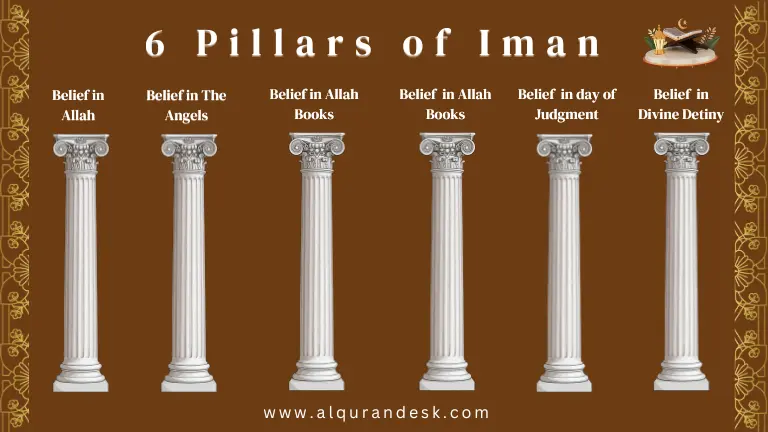
1 The Foundation of Iman- Belief in Allah (Tawheed).
Tawhid entails singling out Allah in:
His Lordship
His right to be worshipped
His Names and Attributes
Allah {Jalla Jalalahu} says:
“Your God is One God. There is no deity worthy of worship except Him.”
(Surah Al-Baqarah 2:163)
Tawhid does not only consist of the conviction that Allah exists, but it is a worship of Him, with love, fear, hope, obedience, and reliance.
Tawheed In Quran and Sunnah.
To have faith in Allah is to say:
Allah alone is the Creator
Only Allah should be worshipped.
Allah has Names and Attributes that are worthy of Himself.
Allah says:
“And your God is One God. All other gods are worthless to be worshipped but only Him.
(Surah Al-Baqarah 2:163)
Tawheed in the Three Categories.
Tawheed is explained by the Ahl-e-Hadith scholars as:
Lordship Tawheed ar-Rububiyyah.
Worship- Tawheed al-Uluhiyyah.
Tawheed al-Asma wa Sifat (without distortion, denial, or analogy) Names and Attributes
The Prophet ﷺ said:
Whoever dies with the knowledge that there is no one entitled to worship him but Allah will go to Paradise.
(Sahih Muslim 26)
Tawhid:
Purifies intention (niyyah)
Eliminates fear of creation
Increases the dependence on Allah.
Insures against baiting and hypocrisy.
2 The faith in the Angels (Malaikah).
Who Are the Angels?
The angels are actual creations of Allah and are made out of light, and they never defy Allah.
They do not disobey Allah in what He commands them.
(Surah At-Tahrim 66:6)
Said the Prophet ﷺ:
The angels were made out of light.
(Sahih Muslim 2996)
Great Angels Worshipped in Authoritative Literature.
Jibreel (Gabriel) – Revelation
Mikaeel – Rain & provision
Israfeel – Blowing the Trumpet.
Malik al-Mawt – Angel of Death
Belief involves saying that they exist, that they have their responsibilities, and that they obey Allah.
3 Belief in the Books of Allah
The Revealed Scriptures
Muslims think that Allah sent books to guide human beings:
Tawrah (Torah)
Zabur (Psalms)
Injeel (Gospel)
Qur’an – Final and preserved
Allah says:
Surely We have revealed, and certainly We protect the Quran.
(Surah Al-Hijr 15:9)
The Quran Is the Ultimate Authority.
The Prophet ﷺ said:
Learners and teachers of the Quran are the best you have.
(Sahih al-Bukhari 5027)
4 The faith in the Prophets of Allah.
Purpose of the Prophets
Allah sent messengers to:
- Call to Tawheed
- Warn against Shirk
- Teach obedience to Allah
And gave them a messenger to every nation that disbelieved in Allah, saying: Worship Allah and forsake false gods.
(Surah An-Nahl 16:36)
Muhammad ﷺ – The Last Messenger.
Muhammad is not the father of any of your men, nor was he the Messenger of Allah, nor the last of the Prophets.
(Surah Al-Ahzab 33:40)
The Prophet ﷺ said:
There shall be no prophet following me.
(Sahih al-Bukhari 3535)
Belief encompasses admiring all the prophets and the last Sunnah.
5 The faith in the Last Day (Akhirah).
What Happens After Death?
There is faith in the Hereafter; it comprises:
Grave life (Barzakh)
Resurrection
Judgment
Paradise & Hellfire
Allah says:
Each soul will have a flavour of death, then unto Us shall be restored.
(Surah Al-Ankabut 29:57)
The Prophet ﷺ said:
The grave is either a part of a paradise garden or a Hell pit.
( Sunan at-Tirmidhi 2460 -Hasan Sahih)
Accountability Is Certain
Whoever makes the weight of an atom good will see it.
(Surah Az-Zalzalah 99:7)
6 The faith in Qadar (Divine Decree).
One of the six pillars of Iman is faith in Qadar (Divine Decree), and if one believes in it in the wrong manner, his/her faith will be considered incomplete. The scholars of Ahl-e-Hadith insist that Qadar should not be distorted, denied or exaggerated in terms of the philosophy.
The Prophet ﷺ laid down clear-cut rules of true belief:
Iman means to believe in Allah, His Angels, His Books, His Messengers, the Last Day, and to believe in Qadar, its good and its bad.
(Sahih Muslim, Hadith 8)
This faith makes a Muslim clear, patient, and balanced, and dependent on Allah in all cases of life.
What Is Qadar in Islam?
Qadar has a language meaning of measure, decree or determination. Qadar is the entire control, prior knowledge, will and the creation of anything that exists in the Islamic way of belief.
Allah {Jalla Jalalahu} says:
Well, we have made everything to a specific measure (Qadar).
(Surah Al-Qamar 54:49)
Nothing occurs randomly. All happiness, trouble, prosperity, procrastination, life and death are occurrences by the wisdom of Allah.
The Four Basic Levels of Qadar
There are four levels of correct belief in Qadar that are inseparable. Denying either of them makes one misplaced in the right Islamic creed.
The faith in the All-Knowledge of Allah (Al-‘Ilm)
Allah knowledge is:
Eternal
Perfect
All-encompassing
He is aware of all the things that happen before, during, and after it occurs.
“Indeed, Allah has knowledge of all things.”
(Surah Al-Baqarah 2:231)
Allah knows:
Who will obey Him
Who will disobey Him
All decisions that a human will take.
Does Qadar Cancel Free Will?
No. Islam disowns two extremes:
Jabariyyah – saying that humans are free of choice.
Qadariyyah – purporting that humans can be in perfect control of destiny.
The moderate Sunni/Ahl-e-Hadith ideology is:
Allah decrees everything
Humans choose actions
Accountability remains
The Prophet {Silla Llahu Alayhi WaSallam) said:
“Strive, for everyone will be facilitated for what they were created for.”
(Sahih al-Bukhari 4949, Sahih Muslim 2647).
Intelligence Beyond Tribulations and Pains.
Belief in Qadar teaches that:
Tests and not punishments are called trials.
Hardships elevate ranks
Delays have wisdom
Allah {Jalla Jalalahu} says:
“And We will surely test you with fear, hunger, loss of wealth, lives, and fruits—but give glad tidings to the patient.”
(Surah Al-Baqarah 2:155)
A believer realises that Allah does not do anything wrong to his servants.
Qadar and Stability of Emotions.
Proper faith in Qadar saves a Muslim against:
Depression over loss
Arrogance over success
Unceasing remorse of the former.
The Prophet ﷺ taught:
“If something befalls you, do not say: ‘If only I had done such-and-such.’ Rather say: ‘Qaddar Allah wa mā shā’a faʿal.’”
(Sahih Muslim 2664)
Making Du’a Despite Qadar
Qadar does not oppose dua, but rather, dua is a part of it. The Prophet {Silla Llahu Alayhi WaSallam} said:
“Nothing repels Qadar except du‘a.”
(Hasan – Tirmidhi 2139)
Du’as in Connection with Qadar.
اللَّهُمَّ إِنِّي أَسْأَلُكَ الرِّضَا بَعْدَ الْقَضَاءِ
Translation:
O Allah, I ask You for contentment after Your decree.
Prayer of Protection against Misguidance.
اللَّهُمَّ مُصَرِّفَ الْقُلُوبِ صَرِّفْ قُلُوبَنَا عَلَى طَاعَتِكَ
Translation:
O Turner of hearts, keep our hearts firm upon Your obedience.
(Sahih Muslim)
Learning Aqeedah for New Muslims & Families
The most crucial thing for any new Muslim is learning Aqeedah (Islamic belief). Aqeedah is a way through which a faithfulperson perceives Allah and worships him as well as leading a life as Islam teaches. Actions are deprived of their real worth without sound belief.
What Is Aqeedah in Islam?
Aqeedah is the essence of what a person believes in and is sure of at the heart when it comes to Islam. It is based on the Quran and true Sunnah, as interpreted by the Salaf (early generations of Islam).
The Aqeedah to New Muslims.
It develops a good association with Allah.
It safeguards against misunderstandings and misconceptions.
It provides meaning on purpose, worship and destiny.
It boosts faith (Iman) at the time of challenges.
Laws were given priority by Prophet spending the earlier years in Makkah teaching Aqeedah.
It is a beautiful start to become a Muslim, and it is necessary to remain with the right knowledge to create a solid foundation. In case you only converted to Islam, or continue to build your faith, New Muslim Course Online with AlQuranDesk is a course that will take you through the process step by step and based on the Quran and original Sunnah. New Muslim Course Online – Master Islam with certainty and clarity. New Muslim Course Online – Learn Islam like a confident, clear and clear Muslim.

Significance of Correct Aqeedah in Islam.
The Prophet ﷺ would have said:
Whoever is bringing into this kind of thing of ours anything that is not of it, it will not be accepted.
(Sahih al-Bukhari 2697)
True faith is a safeguard against:
Shirk
Bid’ah
Misguidance
Learning Aqeedah for New Muslim and Family.
Structured learning is necessary for converts and families in the UK, USA, Europe and the UAE.
The Six Pillars of Iman and the Stability of Mental Health.
Islam had long ago taught in modern psychology:
Anxiety is minimised by believing in Qadar.
Hope in Akhirah discourages desperation.
Belief in Allah creates hope
Allah {Jalla Jalalahu} says:
Verily in the memory of Allah rest hearts.
(Surah Ar-Ra’d 13:28)
A believer with sound Iman:
Handles grief with patience
Faces trials with dignity
Avoids hopelessness
Iman During Trials: The Prophetic Teaching.
Every Prophet was tested:
Nuh (lyh lslm) with rejection
Ibrahim (lyh lslm) with fire
Musa (lyh lslm) with tyranny
Muhammad {Salla Llahu Alayhi WaSallam} through persecution.
Allah says:
Do they think they will be left alone on the ground that they say: We believe?
(Surah Al-Ankabut 29:2)
Both trials are evidence of Iman, not retribution.
The Imanite Body in the Balance of Fear and Hope.
Strong Iman produces:
Honesty
Mercy
Responsibility
Educating Children on the Six Pillars of Iman.
Salaf indoctrinated children in Aqeedah.
It was reported that Ibn Abbas (rDy llh nhm) said:
The Prophet ﷺ said:
I will speak to you words, O little boy…
(Sunan at-Tirmidhi 2516 – Sahih)
Parents should teach:
Who Allah is
Why we worship Him
What happens after death
This creates the undying confidence.
Finding The Knowledge to Learn the Iman Systematically in the Digital Age.
For Muslims in the UK, USA, Europe, UAE. There is limited access to genuine scholars. Alquran desk Worldwide Organise Islamic seminars where tutors are certified.
Conclusion
The Six Pillars of Iman are:
The foundation of salvation
The barrier to false guidance.
The path of the Salaf
Any Islam that lacks proper Aqeedah is not complete.
Any Aqeedah, which lacks Qur’an and Sunnah, is misled.
“And whoever follows other than the path of the believers, We will turn him to what he has chosen.”
(Surah An-Nisa 4:115)
Du‘a for Firm Iman
اللَّهُمَّ يَا مُقَلِّبَ الْقُلُوبِ ثَبِّتْ قُلُوبَنَا عَلَى دِينِكَ
Translation:
O Allah, Turner of hearts, keep our hearts firm upon Your religion.
(Sunan at-Tirmidhi 2140 – Sahih)
How AlQuran Desk Contributes to the Faith Development based on Quran Learning.
It is obligatory always to learn the Quran:
- Discipline
- Consistency
- Emotional restraint
- Trust in gradual progress
Frequently Asked Questions (FAQs)
Are the Six Pillars listed there in the Quran?
Yes. They are well summarised in Surah Al-Baqarah 2:285 and detailed in Hadith.
Are measures of reimbursement of false belief?
No. Righteousness Aqeedah precedes Goods.
Is belief alone enough?
No. Iman contains faith, words and deeds.
Authentic References
Quran References
-
Surah Al-Baqarah 2:285
-
Surah An-Nisa 4:136
-
Surah Al-Baqarah 2:155–157
-
Surah Ta-Ha 20:132
-
Surah An-Nazi‘at 79:40–41
-
Surah An-Nisa 4:31
-
Surah Al-Isra 17:23
-
Surah Al-Baqarah 2:275
-
Surah An-Nisa 4:1
-
Surah An-Nisa 4:19
-
Surah Al-Baqarah 2:228
-
Surah Al-Qamar 54:49
-
Surah Al-Hadid 57:22
-
Surah Al-A‘raf 7:23
-
Surah Al-Baqarah 2:250
Hadith References
-
Sahih Muslim, Hadith 8 (Hadith Jibreel)
-
Sahih al-Bukhari 1469
-
Sahih Muslim 1053
-
Sahih Muslim 2999
-
Sahih al-Bukhari 2766
-
Sahih Muslim 89
-
Sahih al-Bukhari 5976
-
Sahih al-Bukhari 2654
-
Jami‘ at-Tirmidhi 1162 (Hasan Sahih)
-
Sahih Muslim 1218
-
Sunan at-Tirmidhi 3537 (Hasan)
-
Sunan Ibn Majah 4251 (Hasan)
-
Sahih Muslim 2725
Connect with a Quran Teacher
Start learning Holy Quran immediately by connecting with a teacher, right now!
We would love to here from you